Does cannabis affect muscle growth?

Jul 31, 2026The nama Team

Last updated: July 2026

Cannabis doesn’t build muscle, but the research shows it doesn’t block muscle growth either. 

A 2021 review in Sports Medicine found no consistent evidence that cannabis or THC changes muscle size or strength on their own. Cannabis can influence the inputs muscle growth relies on, including sleep, appetite, and post-exercise comfort. The key is sticking with low doses.

nama builds products around precision, with low fixed doses across its relief and recovery line.

Cannabis has no direct effect on muscle size, but dose changes the picture for athletes: low amounts may aid recovery, high amounts might work against you.

Key takeaways

  • Cannabis has no proven direct effect on muscle size or strength gains in either direction, as of the date of publication.
  • Low amounts may support the recovery inputs that muscle growth depends on.
  • High THC doses may interfere with cell signaling tied to muscle growth.
  • Precise, low doses give athletes control over the effect, which is why measured microdoses suit training better than guesswork.

Buzz Drops™ [THC Drink Drops]
On Sale from $27.95
Buzz Drops™ [THC Drink Drops]

2.5mg THC | 2.5mg CBD (per dropper full)

Save up to $41.05 THC
Buzz Packs™ [THC and CBD Powder Drink Mix]
On Sale from $29.95
Buzz Packs™ [THC and CBD Powder Drink Mix]

5mg THC | 5mg CBD (per pack)

Save up to $50.00 THC

Does cannabis help or hurt muscle development?

Muscle growth comes from training and protein synthesis, and cannabis drives neither. Cannabis does not trigger new muscle fibers or speed the protein-building process, so it sits outside the direct mechanics of getting bigger or stronger.

The 2021 review found that cross-sectional comparisons of cannabis users and non-users showed no differences in muscular strength, endurance, or work capacity. Long-term users did not measurably out-lift or under-lift their non-using peers in the available data.

Cannabis shapes the conditions around training rather than the muscle-building itself, and those conditions swing with dose. The rest of the picture comes down to how much and how often.

How do high THC doses work against muscle growth?

Heavy use is where the research turns unfavorable for a lifter. The downsides cluster around high doses.

The 2021 review flagged several high-dose concerns:

  • Cell signaling: High THC doses may slow the cellular pathways involved in muscle growth, though the authors note this needs more direct study.
  • Stress hormones: Heavy use may raise cortisol, a catabolic hormone that works against tissue building.
  • Acute performance: A large dose before training can dull focus, reaction time, and drive, cutting into the quality of the session itself.
  • Lung strain from smoking: Combusted cannabis can reduce stamina over time, a knock-on cost for anyone training hard.

None of these mean you must avoid cannabis, but they do show that you should stick to small doses and avoid smoking.

Can cannabis help with recovery between workouts?

Recovery is where cannabis draws the most athletic interest, since muscle grows during rest rather than during the session. 

A 2024 systematic review screened 901 studies and identified seven meeting its criteria, finding a limited beneficial effect of cannabis on physiological measures such as oxygen use and mean power output, while noting the strength and recovery data remains thin.

Appetite

Many people have difficulty eating enough protein, and THC's appetite effect is well-documented. Building muscle demands a calorie surplus, and some well-managed munchies can help get you there. The 2021 review found THC and THC-based medications reliably stimulated appetite, an effect established enough that a THC medication is approved for appetite loss.

Read about THC for appetite.

Sleep quality

Sleep is the strongest of the indirect muscle growth pathways. Deep sleep is when the body does most of its tissue rebuilding, so anything that helps with sleep feeds the training result.

A 2022 meta-analysis of 39 randomized trials and 5,100 patients found moderate-certainty evidence that medical cannabis produces a small improvement in sleep quality among people with chronic pain. A separate 2021 comparative review found THC-based products shortened the time to fall asleep, though it flagged that tolerance can build with regular use.

Post-exercise soreness

Soreness relief is the shakiest of the three, and the research is split. Some athletes report cannabinoids ease post-workout ache, but controlled trials have not consistently backed it.

A 2023 randomized controlled trial tested a CBD and CBG formulation for delayed onset muscle soreness and found a modest reduction in soreness at 72 hours.

Learn about microdosing cannabis for DOMS.

Does cannabis affect testosterone?

The research pulls in both directions regarding cannabis and testosterone production. Some studies report lower testosterone in cannabis users, others report higher, and a 2023 review of testicular function concluded the current evidence does not support a clinically significant association between cannabis use and testosterone levels.

A 1974 study recorded lower testosterone in heavy chronic users than in non-users, with the reduction tied to dose. Later studies have also found that heavy users have lower testosterone, but a mechanism hasn’t been established, so this could just be correlation.

How does cannabis affect workout performance?

A 2021 review found that THC raises heart rate at a given workload and can affect coordination and perceived effort, neither of which is a training benefit.

Recovery-focused use after a session, or on rest days, avoids performance issues, and many people find it helps with pain and relaxation. The muscle-building work happens between workouts anyway.

What is a good dose for active people?

A low, measured dose keeps you in the range where the recovery upside sits and clear of the high-dose downsides. Because response varies from person to person, starting low is the way to find your level without overshooting.

Here is a simple starting protocol used by some people in the fitness community:

  • Starting dose: 2.5–5 mg THC, or a CBD-forward option for daytime use without a noticeable head effect
  • Timing: Take it after training or in the evening, not before a session
  • For sleep and repair: An evening dose 45–-60 minutes before bed supports the sleep that recovery depends on
  • Adjusting: Hold at your starting dose across several sessions before changing anything, then step up in small increments only if needed

A precise gummy or measured drink drop delivers a known amount every time, which beats the variability of flower where the dose is hard to pin down. Consistency is the whole point when you are tracking how something fits your training.

Learn more about cannabis for athletes.

When to skip cannabis for working out

Cannabis suits some situations and not others, and a few call for caution or a conversation with a doctor first. Knowing when to hold off protects your training and your health.

Hold off or check with a healthcare provider if any of these apply:

  • You take medication that interacts with cannabis: CBD and THC are processed by the liver's CYP450 enzymes, and roughly 60% of prescription drugs use the same pathway, so interactions with blood thinners, sedatives, and other medications are possible
  • You compete under anti-doping rules: THC is prohibited in competition by the World Anti-Doping Agency, and even CBD products can carry trace THC that risks a positive test
  • You are pregnant or breastfeeding: Major medical bodies advise against cannabis use during pregnancy and nursing
  • You have a history of cannabis use disorder: Regular use carries a documented risk of dependence, which research estimates affects roughly 3 in 10 regular users

Persistent trouble with recovery, sleep, or training capacity deserves a professional's input rather than a self-directed fix. A doctor or sports physician can look at your situation and point you toward the right approach.

Product QUIZ

Need help deciding what product is best for you? Take our quiz, just three questions until your perfect match!

Best cannabis edibles for athletes

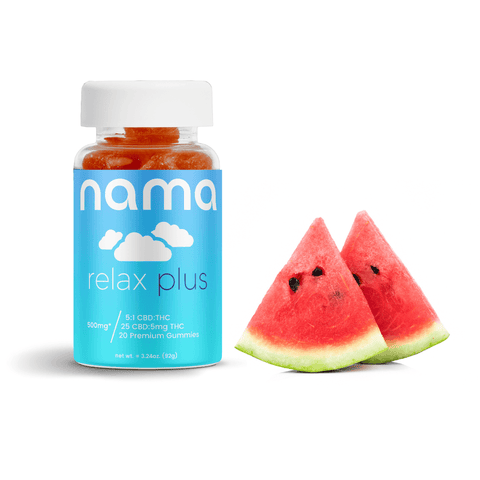
The right product for training recovery is a low, consistent dose in a format you can time around your sessions. nama's recovery-oriented options keep amounts precise and predictable, which matches what the research says about where the benefits sit.

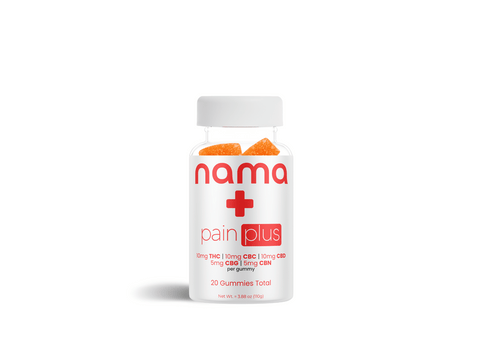
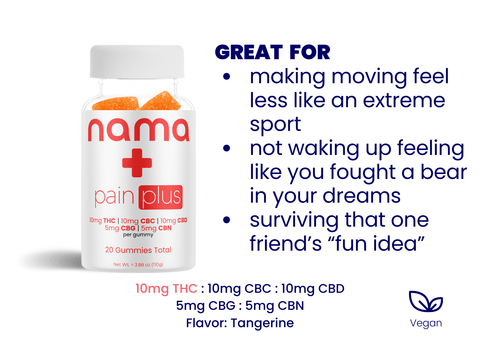
  • Pain Plus gummies: A multi-cannabinoid blend of THC, CBC, CBD, CBG, and CBN per gummy, made for whole-body comfort after hard training. Take one after a session, or start with half if you are new to THC.
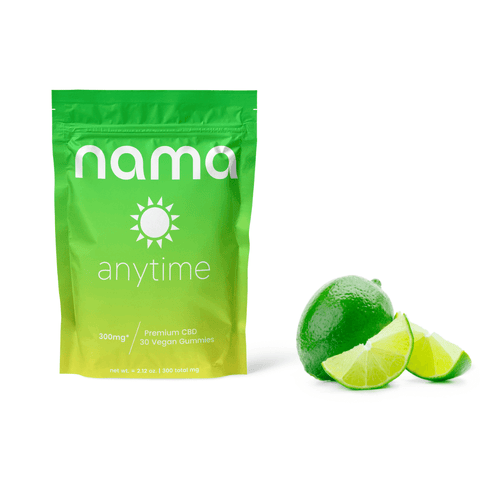
  • Anytime broad-spectrum CBD gummies: 10 mg CBD with zero THC, a daytime option for recovery support without a head effect or drug-test concern.
  • Sleep gummies: CBD, CBN, and melatonin per gummy, aimed at the deep sleep that muscle repair depends on. Take 45-60 minutes before bed.

Precise dosing is the advantage across the line. Every gummy carries a known amount, so you can find what fits your training once and repeat it.

Shop all nama products.

Cannabis for athletes FAQ

Occasional low doses have no proven effect on muscle size or strength, based on the research to date. The concerns concentrate at heavy, high-dose use, where THC may affect growth-related cell signaling and raise stress hormones. Smoking reduces lung capacity over time, so a measured edible or CBD option avoids that particular downside.

CBD draws most of the recovery research, with a 2024 systematic review finding limited but present benefits on physiological measures and interest in its role for sleep and soreness. THC contributes to relaxation and sleep at low doses but carries the acute performance and anti-doping considerations CBD does not. Many active people lean CBD-forward for daytime recovery and reserve low-dose THC for evening use.

Cannabis has no known mechanism for speeding muscle growth directly, based on the research to date. Its value for athletes sits in supporting recovery inputs like sleep and post-exercise comfort, which affect how well the body repairs between sessions. The muscle-building itself still comes from training and nutrition.

Research on cannabis and testosterone is mixed, with studies showing increases, decreases, and no change, and several recent reviews finding no clinically significant association. Any reduction that appears tends to show up in heavy chronic users rather than occasional low-dose ones. A specific hormone concern is worth raising with a doctor.

Keeping cannabis out of the pre-workout window altogether is the cleaner approach, since a dose beforehand can affect focus, coordination, and perceived effort during the session. Recovery-focused use fits better after training or in the evening. The muscle-building work happens during rest anyway, so evening timing serves the goal.

THC is prohibited in competition by the World Anti-Doping Agency and can be detected in testing. Even CBD products marketed as THC-free may contain trace amounts that risk a positive result, since product labeling is not always accurate. Athletes under testing should treat any cannabis product with caution and check their governing body's rules.

Top Sellers

New? Start with our Ultimate Sampler!
Buzz Packs™ [THC and CBD Powder Drink Mix]
On Sale from $29.95
Buzz Packs™ [THC and CBD Powder Drink Mix]

5mg THC | 5mg CBD (per pack)

Save up to $50.00 THC
Buzz Drops™ [THC Drink Drops]
On Sale from $27.95
Buzz Drops™ [THC Drink Drops]

2.5mg THC | 2.5mg CBD (per dropper full)

Save up to $41.05 THC
Pain Plus Gummies | THC, CBD, CBG, CBC, CBN
From $49.00
Pain Plus Gummies | THC, CBD, CBG, CBC, CBN

10mg THC | 10mg CBD | 10mg CBC | 5mg CBG | 5mg CBN (per gummy)

THC
Love | Libido Boosting Gummies With CBD and THC
From $44.00
Love | Libido Boosting Gummies With CBD and THC

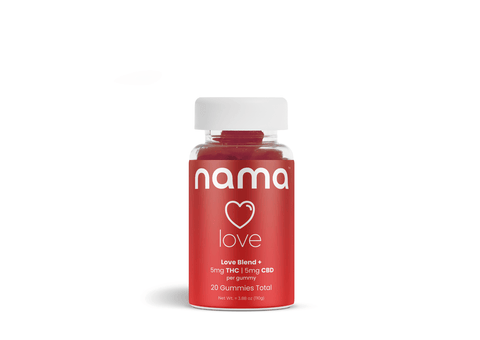
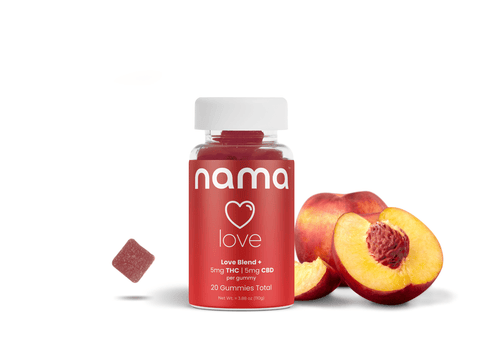
5mg THC | 5mg CBD (per gummy)

THC
The Ultimate nama Gummy Sampler
Save $4.05 THC

Further reading

Microdosing cannabis for weightlifting

Microdosed cannabis vs caffeine as pre-workout

CBD for muscle relaxation

Microdosing cannabis for marathon training

Resources

Burr, J. F., Cheung, C. P., Kasper, A. M., Gillham, S. H., & Close, G. L. (2021). Cannabis and athletic performance. Sports Medicine, 51(Suppl 1), 75-87. https://doi.org/10.1007/s40279-021-01505-x 

Bezuglov, E., Achkasov, E., Rudiakova, E., Shurygin, V., Malyakin, G., Svistunov, D., Butovskiy, M., Fedorova, A., & Kapralova, E. (2024). The effect of cannabidiol on performance and post-load recovery among healthy and physically active individuals: a systematic review. Nutrients, 16(17), 2840. https://doi.org/10.3390/nu16172840 

AminiLari, M., Wang, L., Neumark, S., Adli, T., Couban, R. J., Giangregorio, A., Carney, C. E., & Busse, J. W. (2022). Medical cannabis and cannabinoids for impaired sleep: a systematic review and meta-analysis of randomized clinical trials. Sleep, 45(2), zsab234. https://doi.org/10.1093/sleep/zsab234 

Spanagel, R., & Bilbao, A. (2021). Approved cannabinoids for medical purposes: comparative systematic review and meta-analysis for sleep and appetite. Neuropharmacology, 196, 108680. https://doi.org/10.1016/j.neuropharm.2021.108680 

Peters, E. N., Yardley, H., Harrison, A., Eglit, G. M. L., Antonio, J., Turcotte, C., & Bonn-Miller, M. O. (2023). A randomized, double-blind, placebo-controlled, repeated-dose pilot study of the safety, tolerability, and preliminary effects of a cannabidiol (CBD)- and cannabigerol (CBG)-based beverage powder to support recovery from delayed onset muscle soreness (DOMS). Journal of the International Society of Sports Nutrition, 20(1), 2280113. https://doi.org/10.1080/15502783.2023.2280113 

da Silva, J., Dochez-Arnault, J., Desdoits-Lethimonier, C., Dejucq-Rainsford, N., & Gely-Pernot, A. (2023). The acute exposure of human adult testis tissue to cannabinoids THC and CBD does not impact testosterone production nor germ cell lineage. World Journal of Men's Health, 41(4), 928-939. https://doi.org/10.5534/wjmh.220210 

Kolodny, R. C., Masters, W. H., Kolodner, R. M., & Toro, G. (1974). Depression of plasma testosterone levels after chronic intensive marihuana use. New England Journal of Medicine, 290(16), 872-874. https://doi.org/10.1056/NEJM197404182901602 

nama CBD FDA & legal disclaimer

Our products are not intended to diagnose, treat, cure, or prevent any disease. They are not a replacement for prescription medications and have not been evaluated by the U.S. Food and Drug Administration (FDA).

The information provided on this website does not and is not intended to constitute legal advice or any statement of the status of any laws. Any information, content, and materials available on this site are for general informational purposes only and are not intended to be relied upon for any purpose.

Readers of this website should contact their attorney to obtain advice with respect to any particular legal matter, including decisions on what products are, or are not, legal to sell, possess, or consume. No reader, user, or browser of this site should act or refrain from acting based on the information on this site without first seeking legal advice from their own counsel in the relevant jurisdiction.

More articles

Comments (0)

There are no comments for this article. Be the first one to leave a message!

Leave a comment

Please note: comments must be approved before they are published