Why does weed make you laugh?

Jun 25, 2026The nama Team

Cannabis laughter is caused by a mood and reward shift, a change in how you perceive the world around you, and the social pull of laughter spreading through a group. THC drives all three by binding to CB1 receptors in your endocannabinoid system, the network that helps regulate mood, memory, and how your brain weighs reward. 

A 2016 review found that acute THC increases dopamine release in reward-related brain regions, which sets the mood lift that lowers your threshold for finding things funny. When those receptors light up, the systems that govern emotion, perception, and social response all shift at once. 

We build THC drinks and THC edibles around low, controllable doses, so the social lift stays gentle instead of tipping into the kind of high that makes laughter feel out of control.

It’s common to laugh while high. Cannabis lifts your mood, distorts how you perceive ordinary things, and heightens the contagious pull of laughter in a group.

Key takeaways

  • THC lifts your mood and reward signaling, alters how you perceive ordinary things, and amplifies the social contagion of laughter in a group.
  • The mood lift lowers your threshold for finding things funny, so jokes land harder and small things feel more amusing.
  • Altered perception makes familiar moments register as strange or absurd, which is why everything suddenly seems hilarious.
  • Dose, tolerance, mindset, setting, and THC potency decide whether you get the giggles or feel anxious.
Buzz Drops™ [THC Drink Drops]
On Sale from $27.95
Buzz Drops™ [THC Drink Drops]

2.5mg THC | 2.5mg CBD (per dropper full)

Save up to $41.05 THC
Buzz Packs™ [THC and CBD Powder Drink Mix]
On Sale from $29.95
Buzz Packs™ [THC and CBD Powder Drink Mix]

5mg THC | 5mg CBD (per pack)

Save up to $50.00 THC

THC effects on mood and reward signaling

The starting point for cannabis giggles is a lift in mood. A 2011 placebo-controlled study found that smoked cannabis increased positive affect and reduced negative affect in users, measured against placebo. A better mood lowers the bar for what strikes you as funny, so jokes land harder and small things feel more amusing than they would sober.

Underneath that mood shift is dopamine, your brain's reward chemical. The same review found that acute THC also increases the firing of dopamine neurons, not just their output. That surge is part of why a Delta-9 THC high feels pleasurable and primes you to laugh.

The review noted that long-term, heavy cannabis use may be associated with a blunted dopamine system rather than a heightened one. The giggly reward response belongs to the acute experience, not to chronic daily use, and microdosed THC sits at the gentle end of that acute range.

Learn about the effects of THC on dopamine.

Why does cannabis make normal things feel funnier?

Mood explains why you feel good, but silly moments, like a ceiling fan becoming the funniest object you have ever seen, come from altered perception. THC changes how your brain processes timing, attention, and novelty, so ordinary moments stop feeling ordinary.

A 2013 study found that THC distorted time perception in frequent and infrequent users, with people tending to overestimate how much time had passed. When your sense of timing and sequence loosens, a familiar joke or a slow-motion stumble registers as mistimed and strange, which is fertile ground for laughter.

This is the "benign absurdity" effect. Something feels off-kilter enough to surprise you but safe enough that the surprise reads as funny rather than threatening. A heady, perceptual shift is most tied to the giggles, as opposed to a chill body high.

Read about the differences between a body high and a head high.

Why does laughter spread faster when high in a group?

Most cannabis laughter happens with other people. That’s not surprising, as laughter is fundamentally social. A 2014 paper described laughter as a social emotion tied to bonding and emotional regulation, with most everyday laughter occurring in social interaction rather than in response to actual jokes.

When THC has already lifted your mood and widened your perception, you become more susceptible to the contagious pull of someone else's laugh. One person breaks, then the next, and the feedback loop builds faster than it would sober.

This social amplification is the core of why cannabis fits relaxed, low-stakes hangouts so well. A controllable buzz that keeps you present supports the group dynamic instead of flattening you into the couch.

Why do some people get the giggles while others get anxious?

The same dose that leaves one person laughing can leave another tense and paranoid. These factors decide which way it goes:

  • Dose and THC potency: Higher doses are more likely to flip a pleasant buzz into anxiety. Low, measured doses keep the experience in the social, giggly zone.
  • Tolerance: Regular users often need more to feel the lift, while newcomers can be overwhelmed by a standard dose.
  • Mindset and setting: Feeling safe and relaxed among friends fosters laughter, while stress or an unfamiliar environment leads to unease.

Can cannabis make you laugh uncontrollably?

Uncontrollable laughing fits are a harmless part of being high, driven by the same mood, perception, and contagion loop running at full tilt. For most people, a giggle fit passes on its own and is nothing to worry about.

If the laughter tips into discomfort, paranoia, or a racing heart, a few steps help bring you back down:

  • Move to a calm, quiet space and reduce stimulation.
  • Sip water and slow your breathing to settle your nervous system.
  • Wait it out. The peak fades as THC clears, usually within a couple of hours.

Product QUIZ

Need help deciding what product is best for you? Take our quiz, just three questions until your perfect match!

Best nama products for a controllable social buzz

nama's microdosed, precisely measured products take the guesswork out of giggly hangouts. We recommend these products for fun social settings:

  • Buzz Drops: Liquid THC drops at 2.5 mg THC and 2.5 mg CBD per dropper. Add a dropper to any non-alcoholic drink for a light, social buzz you can dial up or down by half a dropper.
  • Buzz Packs: Each pack contains 5 mg of THC and 5 mg of CBD. Mix into any drink and enjoy the buzz, or half it for a lighter mood lift similar to Buzz Drops.
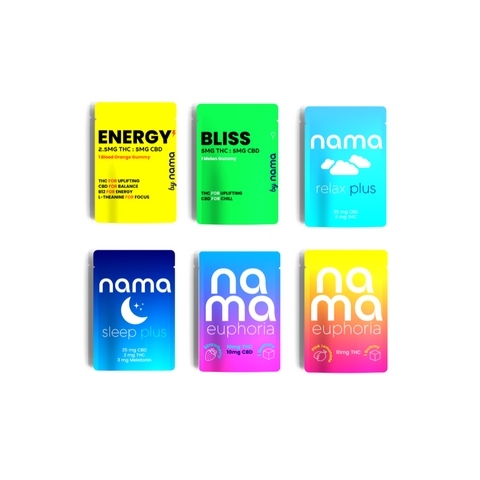
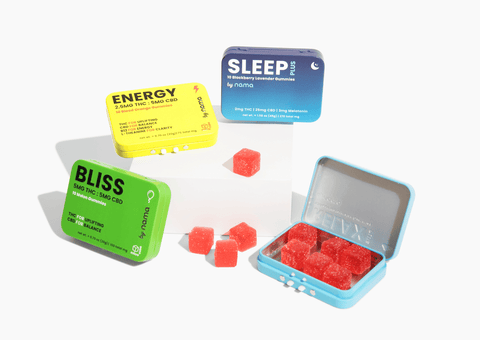
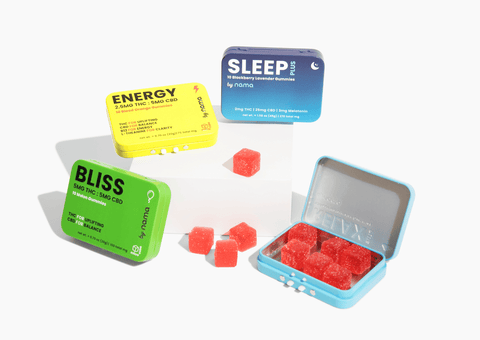
  • Bliss gummies: A simple, consistent 5 mg THC and 5 mg CBD gummy for anyone who wants a fixed, repeatable serving. Take one 45–60 minutes before a social setting for a gentle mood lift without the risk of an unmeasured dose.

New to THC and want to start at the lowest end? The Ultimate nama Sampler lets you try several low-dose formulas and find your comfortable serving before you commit to a full bottle.

Cannabis and laughing FAQ

THC is the cannabinoid most responsible for cannabis laughter, since it activates CB1 receptors tied to mood, reward, and perception. CBD does not produce a high or the same giggly effect, which is why laughter is associated with THC-containing products rather than CBD-only edibles.

Edibles and drinks take longer to kick in, often 30–60 minutes for gummies and 10–20 minutes for water-soluble drinks, while smoking is nearly immediate. The laughter itself comes from the same mechanisms, but the slower, longer onset of edibles tends to produce a more sustained mood than the sharp peak of smoking.

Read about THC bioavailability and how much of it gets absorbed into your system.

Higher doses, low tolerance, an uneasy mindset, or an unfamiliar setting can push the experience toward anxiety or paranoia rather than laughter. Dose is the biggest factor, which is why a measured low-dose serving is far more likely to land in the social, giggly zone.

Strain marketing leans heavily on "giggly" labels, but the older indica and sativa categories are an unreliable guide, and terpene profiles vary widely between plants sold under the same name. The effect depends more on dose, THC potency, mindset, and setting than on any specific strain claim.

Read about whether hybrid weed makes you laugh.

Move to a calmer, less stimulating space, sip water, and slow your breathing to settle your nervous system. The peak fades as THC clears your system, usually within a couple of hours, and choosing a low dose from the start keeps the laughter from getting overwhelming in the first place.

Top Sellers

New? Start with our Ultimate Sampler!
Buzz Packs™ [THC and CBD Powder Drink Mix]
On Sale from $29.95
Buzz Packs™ [THC and CBD Powder Drink Mix]

5mg THC | 5mg CBD (per pack)

Save up to $50.00 THC
Buzz Drops™ [THC Drink Drops]
On Sale from $27.95
Buzz Drops™ [THC Drink Drops]

2.5mg THC | 2.5mg CBD (per dropper full)

Save up to $41.05 THC
Pain Plus Gummies | THC, CBD, CBG, CBC, CBN
From $49.00
Pain Plus Gummies | THC, CBD, CBG, CBC, CBN

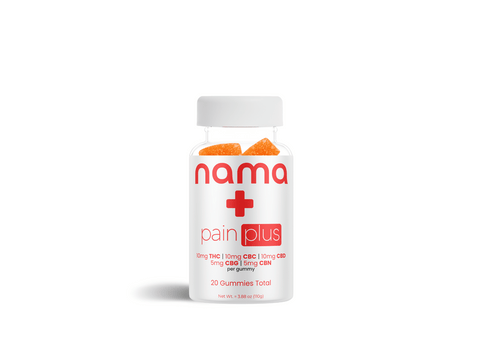
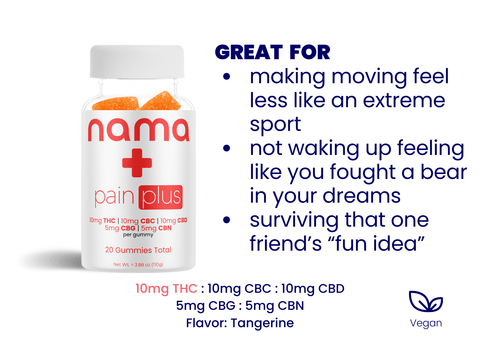
10mg THC | 10mg CBD | 10mg CBC | 5mg CBG | 5mg CBN (per gummy)

THC
Love | Libido Boosting Gummies With CBD and THC
From $44.00
Love | Libido Boosting Gummies With CBD and THC

5mg THC | 5mg CBD (per gummy)

THC
The Ultimate nama Gummy Sampler
Save $4.05 THC

Further reading

The differences between CBD and THC

Microdosing THC for anxiety

What are the best alcohol replacement drinks?

Does Delta 9 THC get you high?

Is a 10 mg edible too much for a beginner?

Resources

Bloomfield, M. A. P., Ashok, A. H., Volkow, N. D., & Howes, O. D. (2016). The effects of Δ9-tetrahydrocannabinol on the dopamine system. Nature, 539(7629), 369–377. https://doi.org/10.1038/nature20153 

Metrik, J., Kahler, C. W., McGeary, J. E., Monti, P. M., & Rohsenow, D. J. (2011). Acute effects of marijuana smoking on negative and positive affect. Journal of Cognitive Psychotherapy, 25(1), 31–46. https://doi.org/10.1891/0889-8391.25.1.31 

Scott, S. K., Lavan, N., Chen, S., & McGettigan, C. (2014). The social life of laughter. Trends in Cognitive Sciences, 18(12), 618–620. https://doi.org/10.1016/j.tics.2014.09.002 

Sewell, R. A., Schnakenberg, A., Elander, J., Radhakrishnan, R., Williams, A., Skosnik, P. D., Pittman, B., Ranganathan, M., & D'Souza, D. C. (2013). Acute effects of THC on time perception in frequent and infrequent cannabis users. Psychopharmacology, 226, 401–413. https://doi.org/10.1007/s00213-012-2915-6 

nama CBD FDA & legal disclaimer

Our products are not intended to diagnose, treat, cure, or prevent any disease. They are not a replacement for prescription medications and have not been evaluated by the U.S. Food and Drug Administration (FDA).

The information provided on this website does not and is not intended to constitute legal advice or any statement of the status of any laws. Any information, content, and materials available on this site are for general informational purposes only and are not intended to be relied upon for any purpose.

Readers of this website should contact their attorney to obtain advice with respect to any particular legal matter, including decisions on what products are, or are not, legal to sell, possess, or consume. No reader, user, or browser of this site should act or refrain from acting based on the information on this site without first seeking legal advice from their own counsel in the relevant jurisdiction.

More articles

Comments (0)

There are no comments for this article. Be the first one to leave a message!

Leave a comment

Please note: comments must be approved before they are published