Cannabis and yoga have been intertwined for thousands of years. Ancient Hindu texts reference cannabis as one of five sacred plants, and Lord Shiva (the Hindu deity who also happens to be the god of yoga) was said to consume cannabis as part of his spiritual practice.
Today, ganja yoga and 420 yoga classes are popping up across the country as modern practitioners rediscover what yogis figured out millennia ago: cannabis and mindful movement tap into the same biological system, and combining them can deepen the experience.
A 2023 University of British Columbia study finds that participants who practiced yoga after consuming cannabis reported significantly higher mindfulness and a deeper sense of physical awareness compared to their usual cannabis activities.
You don't need to smoke a joint before class to experience these benefits. nama's microdosed THC products and cannabis drink drops deliver small, precise cannabinoid doses that enhance your practice without overwhelming it.
What is ganja yoga?
Ganja yoga (also called 420 yoga, cannabis yoga, or stoned yoga) is the practice of consuming cannabis before or during a yoga session to enhance body awareness and mindfulness. Dee Dussault, a certified yoga instructor who pioneered cannabis-enhanced yoga classes in San Francisco, describes it simply: cannabis quiets the ego, pulls you out of your head, and drops you into the physical sensation of being in your body.
Some yoga studios in legal states offer dedicated cannabis yoga sessions where attendees consume before stepping onto the mat. But you can practice cannabis yoga at home with nothing more than a mat, a low-dose edible, and about 45 minutes. Cannabis blends well with gentle yoga styles, like hatha, yin, restorative, and gentle flow, that emphasize internal awareness over athleticism.
The goal isn't to get high and stumble through poses. The goal is to use a small, controlled amount of cannabis to strip away mental noise and connect with your body on a deeper level.
Cannabis and yoga affect the same system
Both cannabis and yoga activate the endocannabinoid system (ECS), a network of receptors, enzymes, and naturally produced cannabinoids that regulates pain perception, mood, inflammation, sleep, and stress response.
When you practice yoga, your body produces endocannabinoids like anandamide, a compound nicknamed the "bliss molecule" for its ability to reduce anxiety and create feelings of calm euphoria. That peaceful, grounded sensation at the end of a yoga session is your ECS at work.
Stacey Mulvey, founder of the cannabis yoga company Marijuasana, states that the flow-state bliss you feel during yoga is the endocannabinoid system activating on a physical level.
Plant-derived cannabinoids from hemp, THC, and CBD interact with the same receptors. THC binds directly to CB1 receptors in the brain, while CBD works indirectly by slowing the enzymes that break down your body's own anandamide.
When you consume a small dose of cannabis before yoga, you're supplementing a system that yoga already activates. Both practices reinforce each other through the same biological pathways, which explains why the combination feels so natural to practitioners who've tried it.
What does the research say about cannabis and yoga?
The most direct study on cannabis and yoga comes from the University of British Columbia (UBC). In 2023, researcher Sarah Elizabeth Ann Daniels had 47 participants self-administer cannabis twice, one week apart. During one session, they practiced 45 minutes of yoga. During the other, they did whatever they'd normally do while high (eating, watching TV, socializing, etc.).
Yoga combined with cannabis significantly improved a sense of mindfulness and mysticality compared to cannabis paired with usual activities. The most frequently reported theme was enhanced physical awareness. Participants described feeling their body and movement on a "deeper" level than sober exercise, and 72% said they'd combine cannabis and yoga again.
Daniels concluded that what you do while under the influence of cannabis matters as much as the dose itself. The concept of "set and setting" has been well-established in psychedelic research but rarely applied to cannabis. Yoga provides an intentional, body-focused, meditative environment that channels cannabis's effects toward mindfulness rather than zoning out.
A 2022 survey published in the Journal of Cannabis Research found that yoga was one of the most popular activities among cannabis users who exercise, with 58% of respondents choosing it as their go-to. Primary motivations included strengthening the mind-body connection and aiding focus.

How does microdosing cannabis enhance yoga practice?
A microdose of cannabis, typically 1–5 mg of THC, enhances yoga in several ways without producing a heavy psychoactive high.
Deeper body awareness
The most commonly reported benefit in the UBC study was enhanced physical awareness. Participants said they felt more "in touch" and "in tune" with their bodies, sensations, and movements at a level they didn't experience during sober yoga. For yoga practitioners, this translates to better proprioception (knowing where your body is in space) and more sensitivity to alignment cues.
Less mental chatter
Cannabis helps disengage the default mode network, the brain circuitry responsible for rumination and self-referential thinking. A microdose takes the volume down on "what should I make for dinner" and "did I send that email," so you can stay present with breath and movement.
Reduced physical tension
THC and CBD have muscle-relaxant properties that may allow deeper stretches and more comfortable holds. For practitioners with chronic stiffness, joint discomfort, or inflammation, cannabis can lower the physical barriers that prevent full engagement with poses.
Read about microdosing cannabis to reduce inflammation.
Enhanced breath connection
THC acts as a bronchodilator, opening airways and facilitating deeper breathing. In a practice built around breath control (pranayama), this physiological effect can amplify the quality of each inhale and exhale.
Greater enjoyment
A University of Colorado study on cannabis and exercise found that participants reported more enjoyable physical activities with cannabis. Yoga practitioners who microdose THC describe their sessions as more pleasurable and intrinsically rewarding.
Read more about the benefits of microdosing THC.
Which yoga styles pair best with cannabis?
Not every yoga style works well with cannabis. The experts who pioneered ganja yoga recommend slower, internally focused practices over fast-paced athletic sequences.
Yin yoga holds passive poses for 3–5 minutes, which targets deep connective tissue. Cannabis enhances yin by helping you relax into long holds and stay present through the discomfort that surfaces during extended stretches. The meditative pace gives microdosed cannabis room to deepen your internal awareness without competing with complex movement sequences.
Restorative yoga uses props (bolsters, blankets, blocks) to support the body in relaxed positions. The emphasis is on calming the nervous system, and cannabis amplifies this effect. For practitioners who struggle to "turn off" during restorative sessions, a small dose of THC can quiet the mind faster than breathwork alone.
Hatha yoga moves at a moderate pace through individual poses with pauses between them. This structure gives you time to notice how cannabis affects your alignment and breath in each posture. Hatha's slower transitions reduce the risk of balance issues that can occur at higher doses.
Gentle vinyasa flow connects poses with breath in a continuous sequence. At microdose levels, cannabis can enhance the flow-state experience, the feeling of moving as one continuous wave rather than a series of discrete postures. Stick to familiar sequences so you're not processing new choreography while feeling the effects.
Skip cannabis when doing hot yoga or power yoga. High-intensity styles raise heart rate and body temperature, and THC can amplify both effects. Cannabis may also impair judgment in demanding sequences, which can increase injury risk. Save the microdose for your recovery-focused practice, not your peak-output one.
How much cannabis should you take before yoga?
For cannabis yoga, the sweet spot is a microdose, enough to shift your state of awareness without compromising coordination or mental clarity.
- If you're new to cannabis: Start with 2.5 mg of THC or less. You can also begin with a CBD-only product (zero THC) to get comfortable with cannabinoids before adding any psychoactive element. CBD alone provides anti-inflammatory and muscle-relaxant benefits that enhance yoga without altering your mental state.
- If you have some cannabis experience: 2.5–5 mg of THC paired with CBD is the standard yoga microdose. The CBD moderates THC's psychoactive effects through the entourage effect, which reduces the chance of anxiety or racing thoughts while enhancing the body-focused benefits.
- If you're experienced with cannabis: You may tolerate 5–10 mg of THC, but more isn't better for yoga. Higher doses can impair proprioception and pull you out of the mindful awareness that makes cannabis yoga valuable in the first place. The goal is subtle enhancement, not intoxication.
Learn more about how to microdose cannabis here.
When should you take cannabis before a yoga session?
Timing depends on your delivery method.
- Edibles (gummies): Take them 60–90 minutes before your practice. Edibles pass through the digestive system, so they take longer to kick in than inhaled methods. The upside is that the effects last 4–8 hours, which covers your entire session plus a relaxed cooldown afterward. If your yoga class starts at 6 PM, take your gummy around 4:30–5:00 PM.
- Liquid drops: Take them 15–30 minutes before practice. Water-soluble THC absorbs faster than standard edibles, with effects beginning in 10–20 minutes. Add a dropper to water or tea as part of your pre-practice ritual.
Product QUIZ
Need help deciding what product is best for you? Take our quiz, just three questions until your perfect match!
Best nama products for cannabis yoga
nama products contain precise, lab-tested doses of cannabinoids that keep your cannabis yoga healthy and predictable. Enjoy American-grown hemp that’s vegan and third-party tested for purity and potency, and get your zen on with these yoga-friendly products:
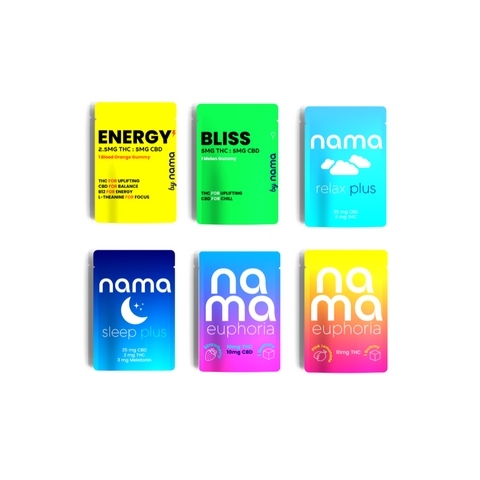
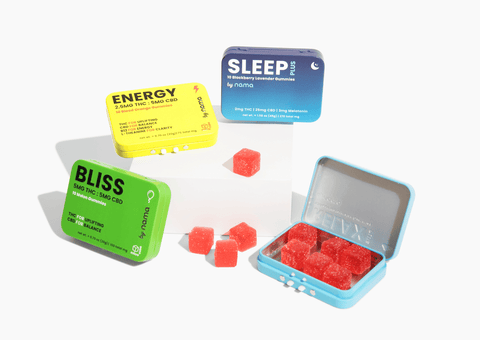
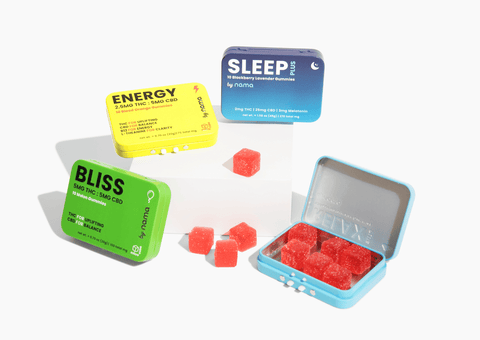
- Bliss gummies are the top pick for cannabis yoga. Each gummy delivers 5 mg of THC and 5 mg of CBD in a 1:1 ratio, the classic microdose to improve awareness without producing a strong high. The melon flavor tastes great, and the 1:1 cannabinoid profile promotes calm euphoria and body relaxation.
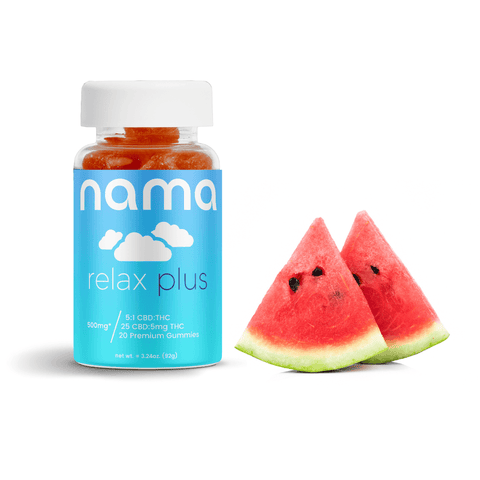
- Relax Plus gummies contain 5 mg of THC and 25 mg of CBD per gummy. The higher CBD-to-THC ratio makes these a strong match for yin and restorative practices where deep relaxation is the goal. The 25 mg CBD dose delivers substantial anti-inflammatory and muscle-relaxant effects that complement long-hold poses.
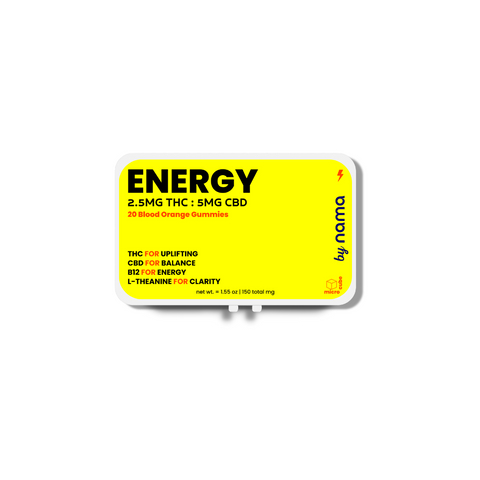
- Energy gummies pair 2.5 mg of THC and 5 mg of CBD with L-theanine and B12. These work well for morning vinyasa flows where you want calm, sustained energy without jitters. The L-theanine promotes alpha brain wave activity, the same brain state associated with meditation and flow.
- Buzz Drops deliver 2.5 mg of THC and 2.5 mg of CBD per dropper in a flavorless liquid. Add them to tea, water, or a pre-practice smoothie. Effects start in 10–20 minutes, making Buzz Drops the fastest-acting nama option for cannabis yoga. They're a solid choice for practitioners who want tight control over timing.
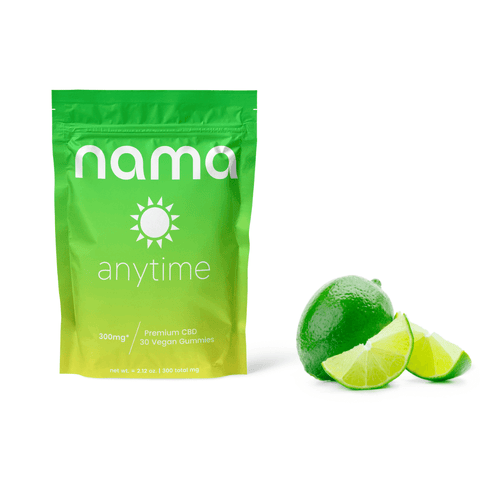
- Anytime CBD gummies contain 10 mg of broad-spectrum CBD with zero THC. For yoga practitioners who want cannabinoid support without any psychoactive effects, or who face drug testing concerns, Anytime gummies offer anti-inflammatory benefits and gentle relaxation without altering your state of mind.
Cannabis for yoga FAQ
Cannabis yoga is safe when you microdose responsibly and stick to slower yoga styles. A 2.5–5 mg dose of THC won't impair your coordination or balance the way higher doses can. Avoid hot yoga, power yoga, or any sequence that requires fast transitions and peak athletic output. Start with familiar poses so your body can move on autopilot while your awareness deepens. Stay hydrated and listen to your body. Cannabis can mask discomfort signals, so don't push beyond your usual range of motion.
Strain classifications (indica, sativa, hybrid) are unreliable because they don't account for individual cannabinoid and terpene profiles. What matters for yoga is the cannabinoid ratio and dose. A low dose of THC combined with CBD produces the calm, focused awareness that yoga practitioners want. nama's hybrid products have exact cannabinoid measurements that help you practice yoga with more consistency and cleanliness than smoking a particular strain can offer.
CBD provides anti-inflammatory, muscle-relaxant, and anxiety-reducing benefits without any psychoactive effects. Many yoga practitioners use CBD-only products to reduce physical tension and quiet mental chatter before class. CBD won't produce the enhanced body awareness that low-dose THC creates, but it's an excellent starting point for newcomers or practitioners who want to avoid THC.
Newcomers to either cannabis or yoga should introduce one at a time before combining them. Get comfortable with basic yoga poses and breathing first, then add a very low dose of cannabis (2.5 mg THC or less) to a familiar routine. Starting with a CBD-only product is another way to ease into 420 yoga.
The UBC study included participants who had never done yoga before, and the results were positive across experience levels, but building a foundation in both practices first gives you better control over the combined experience.
Cannabis and yoga share ancient spiritual origins in India. The Atharva Veda, one of the oldest Hindu texts, names cannabis as one of five sacred plants and calls it a "source of happiness." Lord Shiva, the Hindu deity associated with yoga, was said to consume bhang, a cannabis preparation, as part of his meditative practice.
Tantric cultures that developed many modern yoga postures in the 7th century used cannabis as part of their spiritual practice. The modern ganja yoga movement draws on this historical tradition while adapting it for contemporary wellness.
THC-containing products can trigger a positive result on standard drug tests, even at microdose levels. If drug testing is a concern, use a THC-free option like nama's Anytime CBD gummies (broad-spectrum CBD with zero THC) or nama's CBD-only Sampler to get cannabinoid benefits without the drug test risk.
Top Sellers
New? Start with our Ultimate Sampler!
THC: 10 mg | CBC: 10 mg | CBD: 10 mg | CBG: 5 mg | CBN 5mg
Resources
Daniels, S. E. A. (2023). Cannabis under the influence of yoga : the impact of mindful movement on well-being outcomes after cannabis use (T). University of British Columbia. Retrieved from https://open.library.ubc.ca/collections/ubctheses/24/items/1.0435753
Ogle, W. L., Gold, G. J., Coppen, L. E., & Copriviza, C. (2022). How and why adults use cannabis during physical activity. Journal of cannabis research, 4(1), 24. https://doi.org/10.1186/s42238-022-00134-z
Further Reading
Are there benefits to microdosing cannabis for running?
Microdosing cannabis for muscle recovery
The benefits of cannabis for athletes
How to microdose edibles for focus
What terpenes are good for inflammation?
nama CBD FDA & legal disclaimer
Our products are not intended to diagnose, treat, cure, or prevent any disease. They are not a replacement for prescription medications and have not been evaluated by the Food and Drug Administration (FDA).
The information provided on this website does not and is not intended to constitute legal advice or any statements of the status of any laws. Any information, content, and materials available on this site are for general informational purposes only and are not intended to be relied upon for any purpose.
Readers of this website should contact their attorney to obtain advice concerning any particular legal matter, including decisions on what products are, or are not, legal to sell, possess, or consume. No reader, user, or browser of this site should act or refrain from acting based on information on this site without first seeking legal advice from their own counsel in the relevant jurisdiction.
Only your attorney can provide assurances that the information contained herein—and your interpretation of it—is applicable or accurate for your particular situation. Use of, and access to, this website or any of the links or resources contained within the site do not create an attorney-client relationship between the reader, user, or browser, and website authors, contributors, contributing law firms, or committee members and their respective employers.
About
Learn
Join us on this journey
© Copyright 2026 nama Products LLC. All Rights Reserved.
†These statements have not been evaluated by the Food and Drug Administration. These products are not intended to diagnose, treat, cure or prevent any disease. All information presented here is not meant as a substitute for or alternative to information from health care practitioners. Please consult your health care professional about potential interactions or other possible complications before using any product.
††The information provided on this website does not, and is not intended to, constitute legal advice or any statements of the status of any laws. Any information, content, and materials available on this site are for general entertainment purposes only, and are not intended to be relied upon for any purpose.
nama: The only source for Buzz Drops™
By clicking ‘Yes,’ you agree to our
Terms & Conditions and Privacy Policy
123 John Doe Street
Your Town, YT 12345
Store Hours
Sun: Closed
Mon-Fri: 9:00 - 17:00
Sat: 10:00 - 13:00
What to expect at pickup
Closed
Closing at 5pm
Closing at 5pm
Closing at 5pm
Closing at 5pm
Closing at 5pm
Closing at 1pm

Comments (0)
There are no comments for this article. Be the first one to leave a message!