If you are using CBD for rest, try starting with 15–25 mg about an hour before bed. Then, adjust in 5–10 mg steps based on how you sleep. That range covers the doses tested in a 1,793-person CBD sleep trial and used by a psychiatric clinic treating patients for sleep and anxiety. Your experience with cannabidiol (CBD), your weight, and your timing also impact effects, so you might end up with a personalized dose found through experimentation.
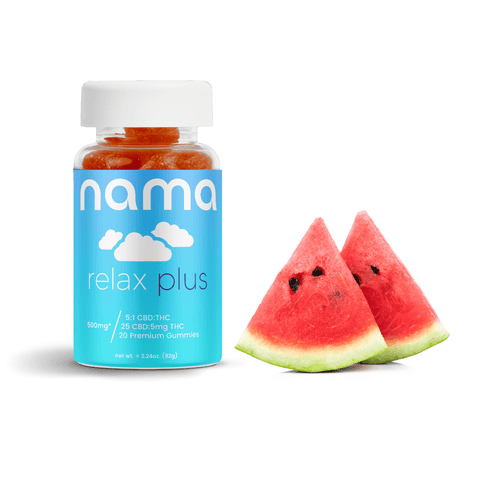
nama’s CBD-only gummies come in 25 mg and 10 mg doses, so you can follow the dose finder below without having to cut anything in half. Both use broad-spectrum hemp extract and are third-party tested.
Key takeaways
- A 2023 trial of 1,793 adults found 15 mg of CBD improved self-reported sleep disturbance about as much as 5 mg of melatonin over four weeks.
- Daily doses near 400 mg raised liver enzymes in 5.6% of healthy adults in a 2025 trial, so climbing higher adds risk with no evidence of extra sleep benefit.
- Start with 15–25 mg of CBD about an hour before bed, and hold that dose for 3–4 nights before you change it.
Will 25 mg of CBD help me sleep?
25 mg is the best-supported place to start, though the evidence behind it is modest. In a 2019 case series from a Colorado psychiatric clinic, nearly every patient took 25 mg of CBD a day in capsule form, and sleep scores improved within the first month for 66.7% of the 72 adults analyzed. Those sleep gains fluctuated over the following months, while improvements in anxiety scores held steady.
Doses below 25 mg show up in the research too. A 2023 randomized trial of 1,793 adults with sleep disturbance found that 15 mg of CBD isolate improved self-reported sleep over four weeks, about as much as 5 mg of melatonin. The trial had no placebo group, so some of that improvement may reflect expectation.
In a 2024 randomized trial of 293 adults with poor sleep, 20 mg of cannabinol (CBN) a night for a week reduced nighttime awakenings and overall sleep disturbance compared with placebo, without adding daytime fatigue. A 2024 meta-analysis of 26 randomized trials found that melatonin shortened the time to fall asleep and lengthened total sleep, with benefits peaking around 4 mg a day.
That puts 15–25 mg of CBD in the sweet spot for a first try, with 10 mg as the gentlest on-ramp for people brand new to CBD. Make 25 mg the dose to beat before you climb.
Will 50 mg of CBD make you sleepy?
50 mg works as a step-up dose for people who found 25 mg too light, not as a starting point. The Colorado clinic in the 2019 case series raised a few patients to 50 or 75 mg a day, and a 1981 study of 15 people with insomnia linked 160 mg to longer sleep and fewer awakenings, though that study was tiny and predates modern sleep-trial methods.
Higher doses also leave your natural sleep cycle intact. In a 2018 crossover trial, 300 mg of CBD didn’t change sleep stages or sleep architecture in 26 healthy volunteers measured with overnight lab sleep studies.
Where should you start by tolerance and body size?
Your CBD experience should set your starting dose, and your body size should nudge it up or down. Prescription CBD is dosed per kilogram of body weight, but no published trial has tested weight-based dosing for over-the-counter CBD gummies. Use weight as a tiebreaker, since larger people may need a little more to notice a difference, while smaller or older people may feel side effects sooner.
The ceiling in each group marks the point to stop climbing and talk with a doctor if you still aren’t sleeping. Past it, the research offers no evidence of extra sleep benefit, and frequent high doses have been linked to liver issues. Our breakdown of how much CBD is too much explores the upper limits.
New to CBD
If CBD is new territory, read up on CBD for beginners before your first night.
- Under 150 lb: Start at 10 mg
- 150–220 lb: Start at 10–20 mg
- Over 220 lb: Start at 20–25 mg
- Ceiling: 50 mg
Occasional CBD user
You take CBD a few times a month and know how it feels.
- Under 150 lb: Start at 20 mg
- 150–220 lb: Start at 25 mg
- Over 220 lb: Start at 25–35 mg
- Ceiling: 75 mg
Daily CBD user
You already take CBD most days, at any time of day.
- Under 150 lb: Start at 25 mg
- 150–220 lb: Start at 25–35 mg
- Over 220 lb: Start at 35–50 mg
- Ceiling: 75 mg, the top of the range used in the 2019 clinic case series
How to step up your dose
- Hold: Stay at one dose for 3–4 nights before you judge it
- Step size: Add 5–10 mg at a time
- Timing: Take it after dinner, 60–90 minutes before bed
- Tracking: Note how long it took you to fall asleep, how many times you woke, and how you felt at 9 a.m.
- When to stop: If two step-ups in a row change nothing, drop back to the lower dose
What form of CBD is most effective for sleep?
Gummies and capsules give you the most predictable dose for sleep, because every piece carries the same labeled amount.
Gummies and capsules
Swallowed CBD takes roughly 30–120 minutes to kick in, since it passes through your gut and liver first. That slow ramp fits a wind-down routine, and CBD gummies for sleep with a labeled 10 mg or 25 mg dose take the guesswork out of counting milligrams.
Oils
Oil held under the tongue can act faster, in about 15–30 minutes, but droppers make precise dosing a little harder. Our look at whether CBD oil helps you sleep covers the trade-offs.
Isolate, broad spectrum, or full spectrum
Spectrum matters less than steady dosing for sleep, so choose based on how you feel about THC. Broad-spectrum CBD has the THC removed, while full spectrum keeps trace THC that some people prefer for the entourage effect.
Take it after dinner
Food changes how much CBD reaches your bloodstream. In a 2019 study of adults taking 99% pure CBD capsules, a high-fat breakfast raised peak blood levels 14-fold and total exposure about fourfold compared with an empty stomach.
Taking your gummy after dinner may get more out of each milligram. Keep the habit consistent, since a heavy meal one night and an empty stomach the next can swing absorption and confuse your results.
Is it bad to take CBD every night to sleep?
Nightly CBD in the 15–50 mg range has a reassuring short-term record, but long-term data is thin and higher doses carry a documented liver signal. In the 2023 trial of 1,793 adults, where every formula contained 15 mg of CBD or 5 mg of melatonin, 12% reported a side effect over four weeks, and none were severe.
In a 2025 randomized trial conducted by FDA researchers, 201 healthy adults took either about 5 mg/kg of CBD a day (roughly 400 mg for an average participant) or a placebo for 28 days, and 5.6% of the CBD group developed liver enzyme levels more than three times the upper limit of normal, compared with no one on placebo. Those levels returned to normal after people stopped CBD.
That dose equals 16 sleep gummies a day, far beyond any sleep routine, but it shows why the lowest dose that works is the right dose. If you take CBD every night for more than a month, mention it at your next checkup so your doctor can factor it into routine bloodwork, and read more about whether CBD is bad for your liver.
What should you not mix CBD with?
Prescription medications top the list, because CBD can change how your liver clears other drugs. Your liver breaks down CBD with the same enzymes (CYP3A4 and CYP2C19) that process many common medications, so CBD can raise or lower their levels in your blood.
Skip CBD, or clear it with your doctor or pharmacist first, if you take any of the following.
- Narrow-margin prescriptions: Warfarin, valproate, tacrolimus, and sirolimus were behind the most reported cannabinoid interactions in a 2024 systematic review
- Sedating medications: Benzodiazepines, prescription sleep aids, opioids, and antihistamine sleep aids can stack drowsiness with CBD
- Alcohol: It adds sedation of its own, and the sleep benefits of going soberish explain why a nightcap fragments sleep later in the night
- Extra sleep supplements: Stacking CBD with additional melatonin or other sleep products makes it impossible to tell which one is working
As a rule of thumb, ask before adding CBD if any of your medications carry a grapefruit warning, because grapefruit and CBD block some of the same liver enzymes. Your pharmacist can check your full list in a few minutes, and Penn State’s free CANN-DIR interaction checker flags known cannabinoid interactions.
Who should skip CBD for sleep?
Some sleep problems need a doctor before any supplement, and a few situations rule CBD out. Skip CBD for sleep (or talk with a doctor first) if any of the following apply:
- Pregnant or breastfeeding: Skip it; nama’s labels advise against use, and our page on CBD safety in pregnancy covers why
- Liver disease or elevated liver enzymes: The 2025 liver findings make this a conversation with your doctor before your first dose
- Loud snoring, gasping, or heavy daytime sleepiness: These point to possible sleep apnea, and a 2024 systematic review found insufficient evidence for cannabinoids in obstructive sleep apnea
- Sleep trouble three or more nights a week for three months or longer: That pattern matches chronic insomnia, and sleep physicians recommend cognitive behavioral therapy for insomnia (CBT-I) as the first step; the research on CBD for insomnia remains early
- Over 65 or taking several medications: A 2026 review notes that nearly all cannabis sleep evidence comes from younger adults, so start at the low end and review your medication list with a doctor; the page on CBD gummy safety for seniors covers this topic in depth
Product QUIZ
Need help deciding what product is best for you? Take our quiz, just three questions until your perfect match!
Which nama gummies match each dose?
nama’s CBD-only gummies come in 25 mg and 10 mg steps, which makes the dose finder above easy to follow. Mix and match them to land on your number without splitting gummies or guessing at droppers.
Sleep gummies for a 25 mg start
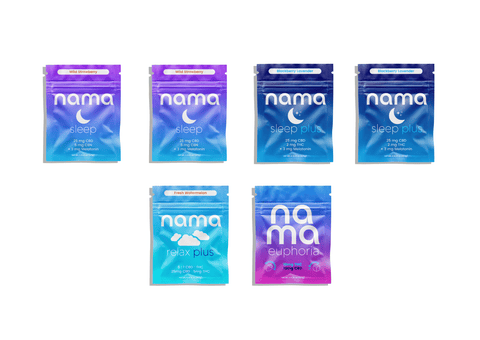
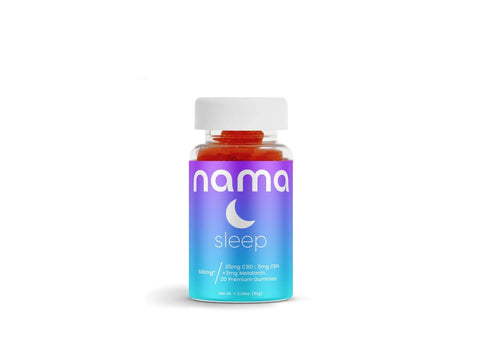
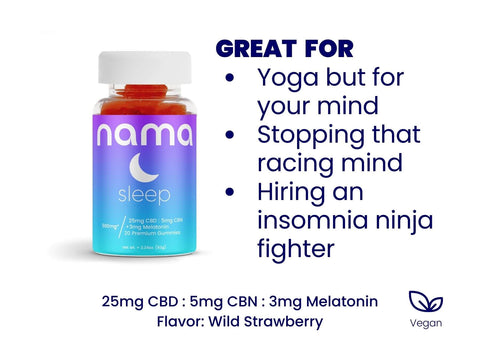
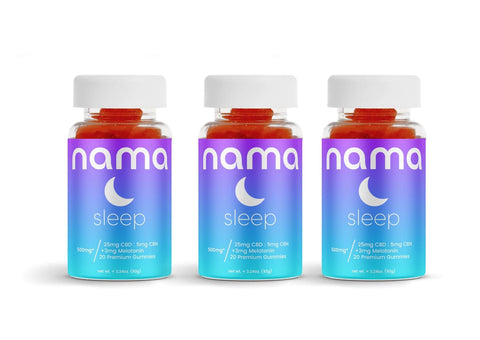
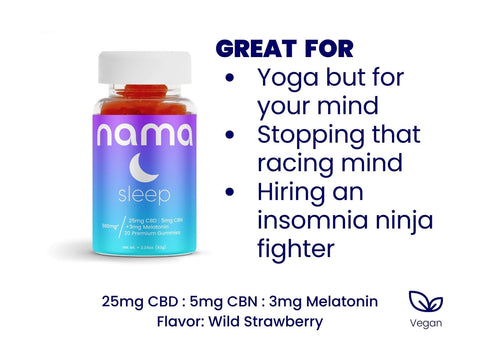
Sleep gummies deliver 25 mg of broad-spectrum CBD, 5 mg of CBN, and 3 mg of melatonin in each wild strawberry gummy, with 20 gummies per bottle. They fit occasional and daily users whose dose finder lands at 25 mg, and the 3 mg of melatonin sits within the 1–5 mg range.
- Dose: 1 gummy
- Timing: After dinner, about 60 minutes before bed
- Stepping up: Add Anytime gummies for more CBD without doubling the melatonin
Anytime gummies in 10 mg building blocks
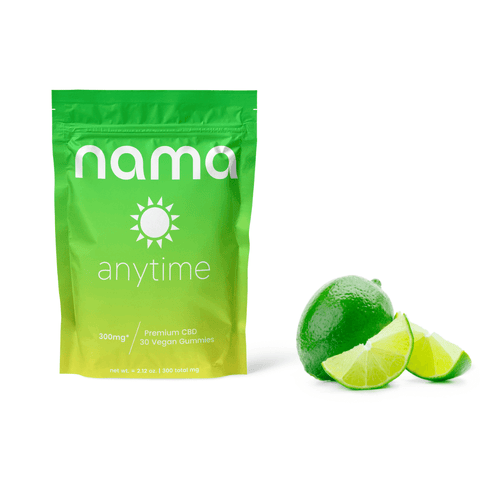
Anytime CBD gummies carry 10 mg of broad-spectrum CBD in a citrus lime gummy, with 30 gummies per bottle. Newcomers can start with one, and anyone stepping up can stack them with a Sleep gummy in clean 10 mg increments.
- Newcomer start: 1 Anytime gummy (10 mg CBD)
- Two steps up: 2 Anytime gummies (20 mg CBD)
- Sleep plus one: 1 Sleep gummy and 1 Anytime gummy (35 mg CBD, 3 mg melatonin)
- Sleep plus two: 1 Sleep gummy and 2 Anytime gummies (45 mg CBD, 3 mg melatonin)
- Timing: Take them together, after dinner
Try before you commit
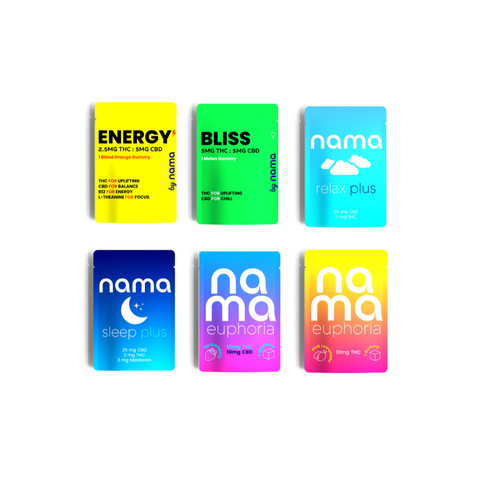
The CBD Gummy Sampler packs single servings of nama’s CBD-only gummies, so you can test a dose before buying a full bottle. Browse the whole CBD collection for daytime options, and set up a subscription on any product page to save 15%.
Want THC in the mix?
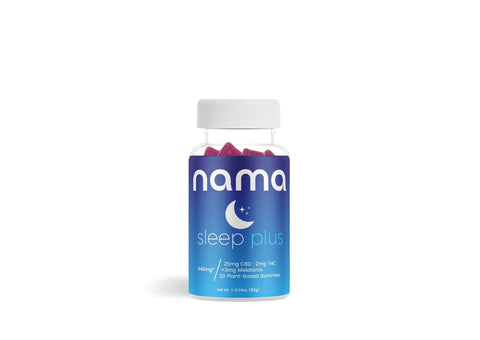
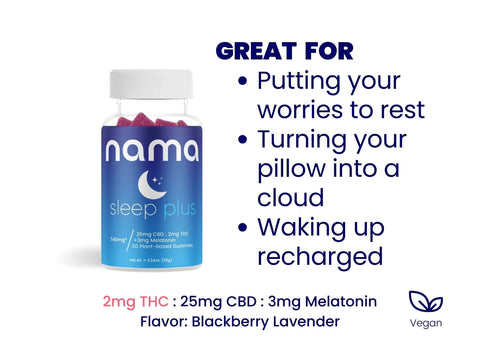
If CBD alone still feels too light after a few weeks, Sleep Plus gummies add 2 mg of THC to 25 mg of CBD and melatonin. Check how much THC helps sleep before you switch, since THC brings impairment that CBD doesn’t.
For a wider comparison of CBD sleep gummies with and without melatonin, including other brands, see our roundup of the best CBD gummies for sleep.
CBD for sleep FAQ
10 mg is one of the lowest doses studied for sleep, and it matches the strictest consumer guidance on record. The UK’s Food Standards Agency advised healthy adults in 2023 to limit CBD from food to 10 mg a day, a precautionary figure based on lifetime exposure, and said it found no acute safety risk above that amount. The US has no equivalent federal limit, which makes 10 mg a cautious starting point.
CBD and melatonin are a common pairing because they act on different systems. Melatonin signals your body clock that it’s night, while CBD interacts with your endocannabinoid system. Count melatonin from every source, since doubling up on combo gummies doubles the melatonin too.
CBD doesn’t produce the high that THC does. At sleep-range doses, the most you should notice is calm and, for some people, drowsiness, and nama’s CBD-only gummies use broad-spectrum extract with the THC removed. See whether CBD makes you high for more information.
Standard workplace drug tests screen for THC metabolites, not CBD, but CBD products can still trip a test. Hemp extracts, including broad-spectrum ones, can carry trace THC, which is why nama’s labels warn that use may result in a failed test. If you face testing, read up on CBD and drug tests and how long CBD stays in your system.
Research on CBD for diagnosed insomnia is early and mixed. In a 2024 randomized pilot trial, 30 adults with moderate-to-severe insomnia took 150 mg of CBD or a placebo under the tongue 60 minutes before bed for two weeks, and measures like time to fall asleep and sleep efficiency didn’t differ between the groups. The CBD group did report higher well-being throughout the trial, which suggests CBD may help more with the wind-down than with the mechanics of sleep, matching the calm, low-key effects that CBD gummy users describe.
A middle-of-the-night gummy can take up to two hours to work and may still be active when your alarm goes off, so adjusting your bedtime dose works better. If you wake up wired most nights, take your evening dose 30 minutes earlier or step up 5–10 mg. Combo gummies give you one more reason to wait, since taking melatonin twice in one night can leave you groggy the next day.
Give each dose 3–4 nights and the whole experiment about a month before you call it. The trials above tracked sleep over two to four weeks, and if a month of careful step-ups hasn’t helped, talk with a doctor about what else might be keeping you up.
Top Sellers
New? Start with our Ultimate Sampler!
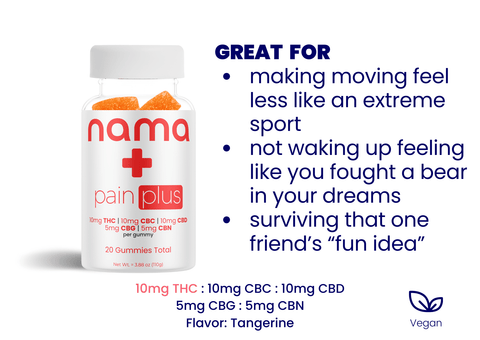
10mg THC | 10mg CBD | 10mg CBC | 5mg CBG | 5mg CBN (per gummy)
Further reading
What are the best sleep gummies for adults?
How much CBN to take for sleep
Resources
Birnbaum, A. K., Karanam, A., Marino, S. E., et al. (2019). Food effect on pharmacokinetics of cannabidiol oral capsules in adult patients with refractory epilepsy. Epilepsia, 60(8), 1586–1592. doi:10.1111/epi.16093
Boylan, P. M., Santibañez, M., Thomas, J., Weeda, E., Noel, Z. R., & Caballero, J. (2024). Cannabinoids for obstructive sleep apnea: A systematic review. Pharmacotherapy, 44(11), 880–891. doi:10.1002/phar.4622
Cannabis for sleep in older adults: Use has outpaced the science. (2026). Journal of Cannabis Research. doi:10.1186/s42238-026-00515-8
Carlini, E. A., & Cunha, J. M. (1981). Hypnotic and antiepileptic effects of cannabidiol. Journal of Clinical Pharmacology, 21(S1), 417S–427S.
Florian, J., Salcedo, P., Burkhart, K., et al. (2025). Cannabidiol and liver enzyme level elevations in healthy adults: A randomized clinical trial. JAMA Internal Medicine. doi:10.1001/jamainternmed.2025.2366
Food Standards Agency. (2023). Food Standards Agency and Food Standards Scotland update consumer advice for CBD. food.gov.uk
Linares, I. M. P., Guimaraes, F. S., Eckeli, A., et al. (2018). No acute effects of cannabidiol on the sleep-wake cycle of healthy subjects: A randomized, double-blind, placebo-controlled, crossover study. Frontiers in Pharmacology, 9, 315. doi:10.3389/fphar.2018.00315
Nachnani, R., Knehans, A., Neighbors, J. D., & Kocis, P. T. (2024). Systematic review of drug-drug interactions of delta-9-tetrahydrocannabinol, cannabidiol, and Cannabis. Frontiers in Pharmacology, 15, 1282831. doi:10.3389/fphar.2024.1282831
Narayan, A. J., Downey, L. A., Rose, S., Di Natale, L., & Hayley, A. C. (2024). Cannabidiol for moderate-severe insomnia: A randomized controlled pilot trial of 150 mg of nightly dosing. Journal of Clinical Sleep Medicine, 20(5), 753–763. PMID: 38174873
Saleska, J. L., Bryant, C., Kolobaric, A., D’Adamo, C. R., et al. (2024). The safety and comparative effectiveness of non-psychoactive cannabinoid formulations for the improvement of sleep: A double-blinded, randomized controlled trial. Journal of the American Nutrition Association, 43(1), 1–11. (Published online 2023.)
Shannon, S., Lewis, N., Lee, H., & Hughes, S. (2019). Cannabidiol in anxiety and sleep: A large case series. The Permanente Journal, 23, 18-041. doi:10.7812/TPP/18-041
nama FDA & legal disclaimer
Our products are not intended to diagnose, treat, cure, or prevent any disease. They are not a replacement for prescription medications and have not been evaluated by the U.S. Food and Drug Administration (FDA).
The information provided on this website does not and is not intended to constitute legal advice or any statement of the status of any laws. Any information, content, and materials available on this site are for general informational purposes only and are not intended to be relied upon for any purpose.
Readers of this website should contact their attorney to obtain advice with respect to any particular legal matter, including decisions on what products are, or are not, legal to sell, possess, or consume. No reader, user, or browser of this site should act or refrain from acting based on the information on this site without first seeking legal advice from their own counsel in the relevant jurisdiction.

More articles
About
Learn
Join us on this journey
© Copyright 2026 nama Products LLC. All Rights Reserved.
†These statements have not been evaluated by the Food and Drug Administration. These products are not intended to diagnose, treat, cure or prevent any disease. All information presented here is not meant as a substitute for or alternative to information from health care practitioners. Please consult your health care professional about potential interactions or other possible complications before using any product.
††The information provided on this website does not, and is not intended to, constitute legal advice or any statements of the status of any laws. Any information, content, and materials available on this site are for general entertainment purposes only, and are not intended to be relied upon for any purpose.
⚠️ CALIFORNIA WARNING: Consuming this product during pregnancy exposes your child to delta-9-THC, which can affect your child’s behavior and learning ability. For more information go to www.P65Warnings.ca.gov/cannabis.
nama: The only source for Buzz Drops™
By clicking ‘Yes,’ you agree to our
Terms & Conditions and Privacy Policy
123 John Doe Street
Your Town, YT 12345
Store Hours
Sun: Closed
Mon-Fri: 9:00 - 17:00
Sat: 10:00 - 13:00
What to expect at pickup
Closed
Closing at 5pm
Closing at 5pm
Closing at 5pm
Closing at 5pm
Closing at 5pm
Closing at 1pm

Comments (0)
There are no comments for this article. Be the first one to leave a message!