Cannabichromene (CBC) is one of hemp's most abundant cannabinoids, but it's also one of the least studied. Lab and animal research links it to several potential effects:
- Inflammation: Lowers inflammatory signaling in cell and animal models
- Pain: Raises pain thresholds in animal tests
- Mood: Produces antidepressant-like effects in mice
- Brain: Supports neural cell activity in early studies
- Skin: Calms oil-producing skin cells in lab research
- Gut: Eases inflammation-driven gut activity in mice
- Bacteria: Acts against drug-resistant bacteria in lab tests
Unlike THC, CBC does not cause a high. It occurs naturally in full-spectrum hemp and appears in our CBC edibles as one of several cannabinoids that produce a relaxed, synergistic experience through the entourage effect.
What is CBC?
CBC begins as cannabigerolic acid (CBGA), converts to cannabichromenic acid (CBCA), then becomes CBC. On its own, it doesn't bind strongly to the CB1 receptors that produce a high, so CBC-only products don’t cause intoxication.
CBC for inflammation
Research shows that CBC helps reduce inflammation. A 1980 rat study first flagged anti-inflammatory activity, and later work filled in the mechanisms. In human macrophage models, CBC affected NLRP3 and IL-6 inflammatory signaling, and in cell and mouse models it lowered inflammatory mediators through NF-κB and MAPK pathways.
CBC for pain
In animal pain tests, CBC has raised pain thresholds without producing a high. A 2011 rat study showed CBC acting on descending pain pathways through CB1, adenosine A1, and TRPA1 signaling, and a 2024 mouse study reduced mechanical allodynia across several pain models.
The effect was consistent in rodents but untested in humans. For a closer look at the pain research, see how CBC interacts with pain.
CBC for mood
Mouse behavior studies have linked CBC to antidepressant-like effects. A 2010 study saw CBC reduce immobility in forced-swim and tail-suspension tests, and a 2025 chronic-stress model reported lower depression-like behavior at 20 mg/kg alongside shifts in corticosterone and MAO-A. One proposed mechanism is CBC slowing the breakdown of anandamide, a signaling molecule tied to mood.
CBC hasn’t been tested on humans as an antidepressant. See cannabis and mental health for more information on microdosing for your mood.
CBC for brain health
CBC has shown activity in neural cell studies. In mouse cells, it increased the viability of adult neural stem and progenitor cells during differentiation, and in NSC-34 cells it turned up genes tied to neuronal differentiation.
This is early cell-level biology. It raises questions that require further research, but its effects on memory, cognition, or brain aging in people haven’t been established.
CBC for skin
Skin research on CBC comes from experiments using human cells in a dish. In cultured human sebocytes (the cells that produce oil), CBC reduced lipid production and calmed inflammatory signaling linked to acne biology.
No human acne trial has tested CBC. The sebocyte work is preliminary, not evidence that CBC clears skin.
CBC for gut health
Gut findings come from mouse models of inflammation. In animal research, CBC normalized inflammation-driven intestinal hypermotility without slowing normal gut movement in healthy controls. Another study showed that, as a TRPA1 agonist, it reduced nitric oxide in macrophages and improved markers of experimental colitis.
Both are animal and cell results. Neither has been repeated in a human digestive condition.
CBC's antimicrobial activity
CBC has shown antibacterial activity in the lab. In a 2008 study, it was one of five cannabinoids active against several drug-resistant MRSA strains in vitro.
Activity against bacteria in a dish is not the same as clearing an infection in a person. No evidence shows CBC treats infections, and it is not an antibiotic.
Are CBC's benefits proven in humans?
There is no CBC-only human trial showing it eases a symptom or improves a condition, so every potential benefit comes from cell or animal studies. A 2026 review catalogs CBC's biological activity while naming the absence of clinical efficacy trials as the field's central gap.
The single CBC-focused human study was a pharmacokinetic pilot in 43 people taking a mixed CBD/THC/CBC oil. It found CBC measurable in blood and well tolerated at daily doses up to 26.4 mg across a week, but it was built to track absorption, not efficacy.
Why is CBC understudied?
CBC sits at low concentrations in most hemp plants and resists clean isolation, so producing pure CBC for research is expensive and slow. Its effects also register as subtle next to THC and CBD, which steers funding toward cannabinoids with larger, easier-to-measure results. That combination leaves few labs working on CBC alone.
CBD earned an FDA-approved drug and a large consumer market, and THC drives most cannabis policy debate, so grant money and industry attention concentrate on those two. CBC stays a minor cannabinoid with a small evidence base as a result.
How CBC works in the body
Research shows that CBC works as a CB2 receptor agonist in cell assays while largely leaving CB1 alone, which fits its non-intoxicating profile. It also engages TRPA1 and other channels and appears to influence anandamide levels, rather than binding and strongly activating CB1 the way THC does.
CBC and the entourage effect
The entourage effect describes how cannabinoids, terpenes, and other plant compounds can change each other's activity when taken together. For a subtle cannabinoid like CBC, value comes from what CBC adds to a blend, not from isolated potency.
Much of the CBC research reflects this, using mixtures instead of isolated CBC. A 2023 arthritis study found CBC combined with CBD outperformed either one alone on some inflammation measures, and older work showed THC changing CBC's effects when the two were given together.
Because CBC acts on different targets than THC and CBD, it can broaden how a full-spectrum product engages the endocannabinoid system. nama builds CBC into full-spectrum edibles and drops for that reason.
CBC vs CBD
CBD and CBC are both non-intoxicating cannabinoids built from the same CBGA precursor, yet they act differently in the body. CBD spreads its activity across many targets, which gives it broad, well-mapped effects. CBC works through a narrower set of pathways, so its activity reads as more specialized and, so far, subtler.
The plant makes them in different amounts too. CBD is abundant and extracts cleanly, so it anchors most hemp products, while CBC shows up in smaller quantities and resists isolation. That scarcity is a practical reason CBC most often appears inside full-spectrum blends.
Product QUIZ
Need help deciding what product is best for you? Take our quiz, just three questions until your perfect match!
nama products with CBC
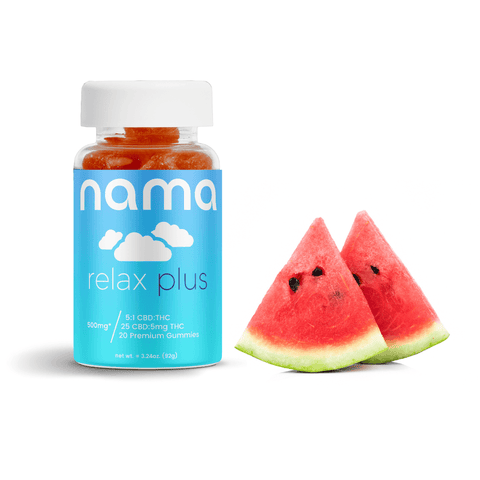
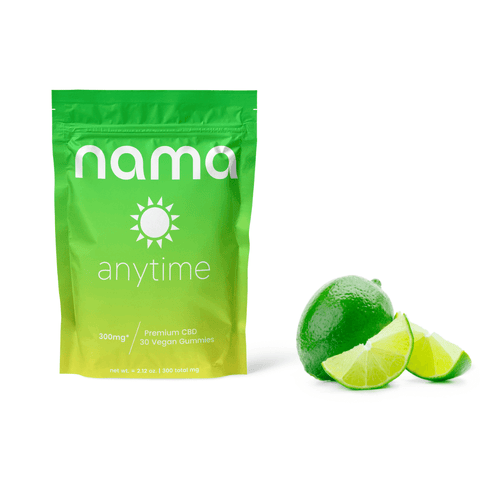
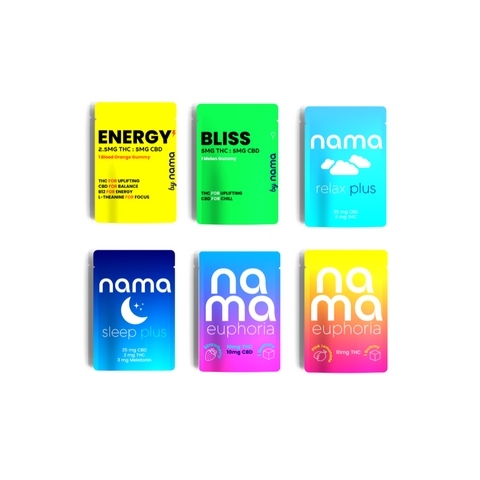
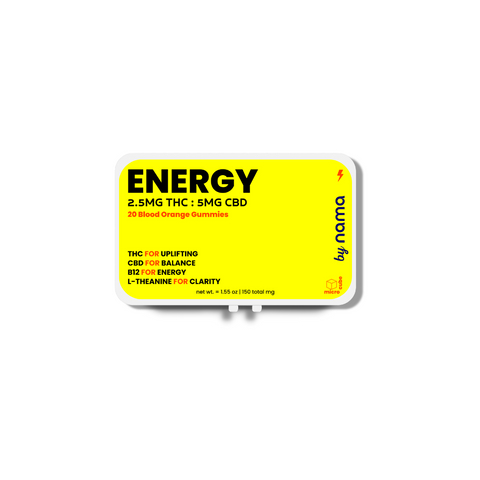
nama makes precisely dosed, lab-tested hemp edibles and drops. CBC is a natural component of full-spectrum cannabis, so we keep it in our multi-cannabanoid formulations to create a stronger entourage effect.
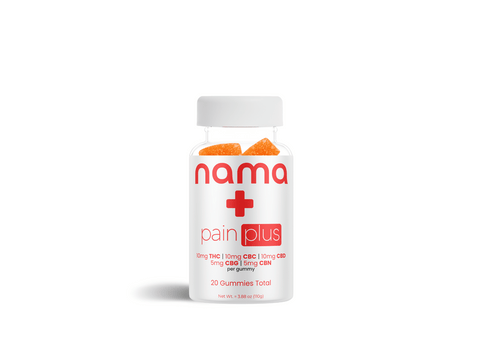
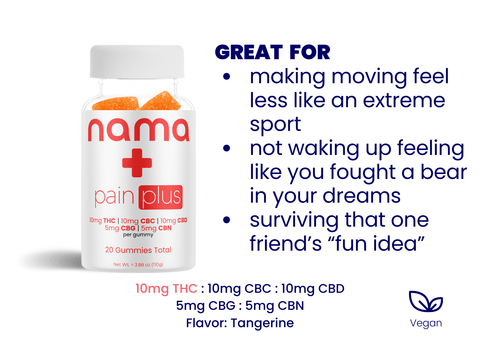
- Pain Plus gummies: Five cannabinoids per gummy, including 10 mg CBC next to 10 mg THC, 10 mg CBD, 5 mg CBG, and 5 mg CBN.
- Extra Strength Sleep Drops: An evening blend with 5 mg CBC per drop, plus 100 mg CBD, 2.5 mg THC, CBG, and other minor cannabinoids.
In both, CBC is one of several cannabinoids in each serving, not the main active ingredient. To see our full range, browse all nama products.
CBC benefits FAQ
CBC is non-intoxicating on its own. It doesn't bind strongly to the CB1 receptors responsible for a cannabis high, so by itself it won't produce one. In a full-spectrum product, any noticeable head change comes from the THC in the formula, not the CBC.
On its own, CBC is subtle, so most people won't notice a distinct "CBC effect" the way they feel THC. Inside full-spectrum products, what you feel comes mostly from the THC and CBD, not the CBC.
CBC has no human anxiety trials, and most anxiety claims trace back to combination products or to CBD rather than isolated CBC. Though cannabis can relax you, anyone dealing with anxiety is better served by a clinician than by a minor cannabinoid.
CBC hasn’t been studied for sleep. CBN and CBD get more sleep-related attention, and any drowsiness from a full-spectrum product is more likely traced to THC or added ingredients like melatonin than to CBC.
In animal research, CBC has shown cytotoxic activity against cancer cell lines and reduced tumor growth in some mouse models, including glioma and pancreatic models, but there is no human cancer research on this topic yet.
Human safety data is limited to one short pharmacokinetic study, which reported CBC was well tolerated at daily doses up to 26.4 mg over a week in a mixed cannabinoid product. Long-term safety, organ effects, and drug interactions haven't been mapped, so that isn't a clean bill of health. Check with a doctor if you take other medications.
Top Sellers
New? Start with our Ultimate Sampler!
10mg THC | 10mg CBD | 10mg CBC | 5mg CBG | 5mg CBN (per gummy)
Further reading
Best CBD for joint pain relief
Hybrid weed and the entourage effect
Microdosing cannabis for nausea
Resources
Anderson, L. L., Ametovski, A., Luo, J. L., Everett-Morgan, D., McGregor, I. S., Banister, S. D., & Arnold, J. C. (2021). Cannabichromene, related phytocannabinoids, and 5-fluoro-cannabichromene have anticonvulsant properties in a mouse model of Dravet syndrome. ACS Chemical Neuroscience, 12(2), 330–339. https://doi.org/10.1021/acschemneuro.0c00677
Appendino, G., Gibbons, S., Giana, A., Pagani, A., Grassi, G., Stavri, M., Smith, E., & Rahman, M. M. (2008). Antibacterial cannabinoids from Cannabis sativa: A structure-activity study. Journal of Natural Products, 71(8), 1427–1430. https://doi.org/10.1021/np8002673
Davis, W. M., & Hatoum, N. S. (1983). Neurobehavioral actions of cannabichromene and interactions with delta-9-tetrahydrocannabinol. General Pharmacology, 14(2), 247–252. https://doi.org/10.1016/0306-3623(83)90004-6
DeLong, G. T., Wolf, C. E., Poklis, A., & Lichtman, A. H. (2010). Pharmacological evaluation of the natural constituent of Cannabis sativa, cannabichromene, and its modulation by delta-9-tetrahydrocannabinol. Drug and Alcohol Dependence, 112(1–2), 126–133. https://doi.org/10.1016/j.drugalcdep.2010.05.019
El-Alfy, A. T., Ivey, K., Robinson, K., Ahmed, S., Radwan, M., Slade, D., Khan, I., ElSohly, M., & Ross, S. (2010). Antidepressant-like effect of delta-9-tetrahydrocannabinol and other cannabinoids isolated from Cannabis sativa L. Pharmacology Biochemistry and Behavior, 95(4), 434–442. https://doi.org/10.1016/j.pbb.2010.03.004
Ghasemi Gojani, E., Wang, B., Li, D.-P., Kovalchuk, O., & Kovalchuk, I. (2023). Anti-inflammatory effects of minor cannabinoids CBC, THCV, and CBN in human macrophages. Molecules, 28(18), 6487. https://doi.org/10.3390/molecules28186487
Grogan, G., Stephens, K., Chou, J., Timko, M. P., Cottler, P., & DeGeorge, B. R., Jr. (2023). The mechanism of cannabichromene and cannabidiol alone versus in combination in the alleviation of arthritis-related inflammation. Annals of Plastic Surgery, 90(6S Suppl 4), S408–S415. https://doi.org/10.1097/SAP.0000000000003547
Hong, M., Kim, J.-H., Han, J.-H., Ryu, B.-R., Lim, Y.-S., Lim, J.-D., Park, S.-H., Kim, C.-H., Lee, S.-U., & Kwon, T.-H. (2023). In vitro and in vivo anti-inflammatory potential of cannabichromene isolated from hemp. Plants, 12(23), 3966. https://doi.org/10.3390/plants12233966
Hwang, Y.-N., Park, J.-H., Na, H.-H., Kwon, T.-H., Park, J.-S., Chae, S., Oh, Y. T., & Kim, K.-C. (2025). Cannabichromene: Integrative modulation of apoptosis, ferroptosis, and endocannabinoid signaling in pancreatic cancer therapy. Cell Death Discovery, 11, 377. https://doi.org/10.1038/s41420-025-02674-8
Izzo, A. A., Capasso, R., Aviello, G., Borrelli, F., Romano, B., Piscitelli, F., Gallo, L., Capasso, F., Orlando, P., & Di Marzo, V. (2012). Inhibitory effect of cannabichromene, a major non-psychotropic cannabinoid extracted from Cannabis sativa, on inflammation-induced hypermotility in mice. British Journal of Pharmacology, 166(4), 1444–1460. https://doi.org/10.1111/j.1476-5381.2012.01879.x
Ligresti, A., Moriello, A. S., Starowicz, K., Matias, I., Pisanti, S., De Petrocellis, L., Laezza, C., Portella, G., Bifulco, M., & Di Marzo, V. (2006). Antitumor activity of plant cannabinoids with emphasis on the effect of cannabidiol on human breast carcinoma. Journal of Pharmacology and Experimental Therapeutics, 318(3), 1375–1387. https://doi.org/10.1124/jpet.106.105247
Maione, S., Piscitelli, F., Gatta, L., Vita, D., De Petrocellis, L., Palazzo, E., de Novellis, V., & Di Marzo, V. (2011). Non-psychoactive cannabinoids modulate the descending pathway of antinociception in anaesthetized rats through several mechanisms of action. British Journal of Pharmacology, 162(3), 584–596. https://doi.org/10.1111/j.1476-5381.2010.01063.x
Milligan, C. J., Anderson, L. L., McGregor, I. S., Arnold, J. C., & Petrou, S. (2023). Beyond CBD: Inhibitory effects of lesser studied phytocannabinoids on human voltage-gated sodium channels. Frontiers in Physiology, 14, 1081186. https://doi.org/10.3389/fphys.2023.1081186
Oláh, A., Markovics, A., Szabó-Papp, J., Szabó, P. T., Stott, C., Zouboulis, C. C., & Bíró, T. (2016). Differential effectiveness of selected non-psychotropic phytocannabinoids on human sebocyte functions. Experimental Dermatology, 25(9), 701–707. https://doi.org/10.1111/exd.13042
Peters, E. N., MacNair, L., Mosesova, I., Christians, U., Sempio, C., Klawitter, J., Land, M. H., Ware, M. A., Turcotte, C., & Bonn-Miller, M. O. (2022). Pharmacokinetics of cannabichromene in a medical cannabis product also containing cannabidiol and delta-9-tetrahydrocannabinol: A pilot study. European Journal of Clinical Pharmacology, 78(2), 259–265. https://doi.org/10.1007/s00228-021-03232-8
Raup-Konsavage, W. M., Sepulveda, D. E., Wang, J., Dokholyan, N. V., Vrana, K. E., & Graziane, N. M. (2024). Antinociceptive effects of cannabichromene (CBC) in mice: Insights from von Frey, tail-flick, formalin, and acetone tests. Biomedicines, 12(1), 83. https://doi.org/10.3390/biomedicines12010083
Romano, B., Borrelli, F., Fasolino, I., Capasso, R., Piscitelli, F., Cascio, M. G., Pertwee, R. G., Coppola, D., Vassallo, L., Orlando, P., Di Marzo, V., & Izzo, A. A. (2013). The cannabinoid TRPA1 agonist cannabichromene inhibits nitric oxide production in macrophages and ameliorates murine colitis. British Journal of Pharmacology, 169(1), 213–229. https://doi.org/10.1111/bph.12120
Sepulveda, D. E., Vrana, K. E., Kellogg, J. J., Bisanz, J. E., Desai, D., Graziane, N. M., & Raup-Konsavage, W. M. (2024). The potential of cannabichromene (CBC) as a therapeutic agent. The Journal of Pharmacology and Experimental Therapeutics, 391(2), 206–213. https://doi.org/10.1124/jpet.124.002166
Sharma, A., Singh, R., Virmani, T., Chouhan, N. K., Kapoor, G., Kumar, G., Bhutani, R., Rana, N., & Sharma, S. (2025). Cannabichromene, a key non-psychotropic phytocannabinoid in treatment of major depressive disorder: In silico and in vivo explorations. Naunyn-Schmiedeberg's Archives of Pharmacology, 398(11), 15611–15630. https://doi.org/10.1007/s00210-025-04236-2
Shinjyo, N., & Di Marzo, V. (2013). The effect of cannabichromene on adult neural stem/progenitor cells. Neurochemistry International, 63(5), 432–437. https://doi.org/10.1016/j.neuint.2013.08.002
Udoh, M., Santiago, M., Devenish, S., McGregor, I. S., & Connor, M. (2019). Cannabichromene is a cannabinoid CB2 receptor agonist. British Journal of Pharmacology, 176(23), 4537–4547. https://doi.org/10.1111/bph.14815
Valeri, A., Chiricosta, L., D'Angiolini, S., Pollastro, F., Salamone, S., & Mazzon, E. (2023). Cannabichromene induces neuronal differentiation in NSC-34 cells: Insights from transcriptomic analysis. Life, 13(3), 742. https://doi.org/10.3390/life13030742
Wirth, P. W., Watson, E. S., ElSohly, M., Turner, C. E., & Murphy, J. C. (1980). Anti-inflammatory properties of cannabichromene. Life Sciences, 26(23), 1991–1995. https://pubmed.ncbi.nlm.nih.gov/7401911/
nama CBD FDA & legal disclaimer
Our products are not intended to diagnose, treat, cure, or prevent any disease. They are not a replacement for prescription medications and have not been evaluated by the U.S. Food and Drug Administration (FDA).
The information provided on this website does not and is not intended to constitute legal advice or any statement of the status of any laws. Any information, content, and materials available on this site are for general informational purposes only and are not intended to be relied upon for any purpose.
Readers of this website should contact their attorney to obtain advice with respect to any particular legal matter, including decisions on what products are, or are not, legal to sell, possess, or consume. No reader, user, or browser of this site should act or refrain from acting based on the information on this site without first seeking legal advice from their own counsel in the relevant jurisdiction.

About
Learn
Join us on this journey
© Copyright 2026 nama Products LLC. All Rights Reserved.
†These statements have not been evaluated by the Food and Drug Administration. These products are not intended to diagnose, treat, cure or prevent any disease. All information presented here is not meant as a substitute for or alternative to information from health care practitioners. Please consult your health care professional about potential interactions or other possible complications before using any product.
††The information provided on this website does not, and is not intended to, constitute legal advice or any statements of the status of any laws. Any information, content, and materials available on this site are for general entertainment purposes only, and are not intended to be relied upon for any purpose.
⚠️ CALIFORNIA WARNING: Consuming this product during pregnancy exposes your child to delta-9-THC, which can affect your child’s behavior and learning ability. For more information go to www.P65Warnings.ca.gov/cannabis.
nama: The only source for Buzz Drops™
By clicking ‘Yes,’ you agree to our
Terms & Conditions and Privacy Policy
123 John Doe Street
Your Town, YT 12345
Store Hours
Sun: Closed
Mon-Fri: 9:00 - 17:00
Sat: 10:00 - 13:00
What to expect at pickup
Closed
Closing at 5pm
Closing at 5pm
Closing at 5pm
Closing at 5pm
Closing at 5pm
Closing at 1pm

Comments (0)
There are no comments for this article. Be the first one to leave a message!