The legal hemp market in the US has a counterfeiting problem. Since the 2018 Farm Bill legalized hemp-derived THC products, hundreds of brands have entered the market with minimal oversight. Many of them copy the names and packaging of established products, then sell an inferior, untested version to consumers who think they're getting the original.
This is a branding and a safety issue. Counterfeit cannabis products can contain inaccurate doses, undisclosed ingredients, pesticides, heavy metals, and residual solvents. Consumers have no way to verify what's inside a product that hasn't been tested by an accredited third-party lab.
Our product, Buzz Drops™, has been one of the most copied THC drink mix products in the US, which prompted us to make this guide. But the principles here apply to any cannabis product you're considering.
Why cannabis copycats exist
The hemp-derived THC market is regulated at the state level, not the federal level, so no single agency enforces ingredient accuracy or testing requirements nationwide. This regulatory gap creates an environment where any company can:
- Launch a THC product without third-party testing
- Print any dose on the label without verification
- Copy the name and branding of a popular product
- Sell through third-party marketplaces with no accountability
The barrier to entry is low, the profit margins can be high, and the enforcement mechanisms are nearly nonexistent. This is why copycat products proliferate, and why the burden of verification falls on consumers.
Red flags that indicate a copycat or low-quality product
Low-quality and copycat brands often have professional websites and sell their products on Amazon and other legitimate marketplaces. Look past polished brand appearances at the following details to spot these red flags:
No third-party lab results
A reputable cannabis company tests every production batch at an independent, accredited laboratory and publishes the results as Certificates of Analysis (COAs). The COA should verify cannabinoid potency, pesticide levels, heavy metal content, residual solvents, and microbial contamination.
If a brand doesn't publish COAs, publishes results from an unaccredited lab, or only shows a single COA that doesn't match the current batch, treat the product as unverified.
Undisclosed hemp sourcing
Hemp absorbs contaminants from soil and water, which means hemp grown in polluted conditions or without agricultural oversight can carry pesticides, heavy metals, and other toxins into the final product.
Reputable brands disclose their hemp sourcing. Typically, American farms that operate under state programs established by the 2018 Farm Bill. If a brand doesn't mention where its hemp comes from, they probably want to conceal the source.
Ingredient lists that are vague, missing, or excessively long
A clear, short ingredient list means the manufacturer knows exactly what's in the product and isn't hiding behind proprietary blend language or filler ingredients.
For example, nama Buzz Drops contain just three ingredients: purified water, water-soluble THC, and water-soluble CBD. Copycat THC drops often list 10–15+ ingredients, including artificial flavors, sweeteners, stabilizers, gums, and preservatives.
Name mimicry and packaging imitation
Copycats use names that are identical or similar to established products, package their product in look-alike bottles, and copy taglines and color schemes. The goal is to make consumers assume they're buying the original.
Read nama's guide to spotting authentic Buzz Drops to learn more about how copycats have targeted our brand.
Sold exclusively through third-party marketplaces
Established cannabis brands sell through their own websites because direct-to-consumer sales give them control over the supply chain, product handling, and customer experience. A product that's available only on Amazon, eBay, or a third-party website, with no dedicated brand website to back it up, warrants skepticism. That said, most legitimate brands sell through these channels in addition to their own websites.
No customer service or brand presence
Legitimate cannabis companies have a public presence, a website with detailed product information, customer support channels, published lab results, and a traceable business address. Copycat operations often lack one or more of these. If you can't find a phone number, email address, physical location, or any way to contact the company behind a product, that's a signal to walk away.

What can happen if you buy a counterfeit cannabis product?
- Inaccurate dosing: A product labeled as 2.5 mg THC per serving might contain 5 mg, 10 mg, or more. For someone expecting a microdose of THC, an unexpectedly high dose can trigger anxiety, paranoia, rapid heartbeat, and an experience that feels nothing like what was advertised. Underdosing is also common and annoying since you’re paying for a product that doesn’t deliver.
- Dangerous contaminants: Pesticides, heavy metals (lead, mercury, arsenic, cadmium), and residual solvents from extraction can accumulate in your body with repeated use. Without lab testing, these contaminants go undetected.
- Allergic reactions, interactions with medications, or unwanted side effects: Some counterfeit products have been found to contain synthetic cannabinoids, lab-created compounds that mimic THC but carry significantly higher health risks. No accountability means that if something goes wrong, there is no company to contact and no recourse for the consumer.
How to safely buy cannabis products
- Buy from the brand's official website. This eliminates the risk of purchasing a counterfeit product.
- Check for batch-specific COAs. The lab results should be recent and come from an accredited third-party laboratory, not an in-house lab run by the brand itself.
- Read the ingredients. Short ingredient lists usually signal higher quality and better quality control. Be wary of proprietary blends that don't disclose specific amounts.
- Verify hemp sourcing. American-farmed hemp grown under state agricultural programs provides a baseline of regulatory oversight. If a brand doesn't disclose sourcing, assume there's a reason.
- Look for a real company behind the product. A physical address, customer service contact information, a founder with a public identity, and an established track record all signal legitimacy.
- Compare ingredient lists against the original. If you're trying to buy a specific product, check the original brand's website for the exact ingredient list and dosing, then compare.
Product QUIZ
Need help deciding what product is best for you? Take our quiz, just three questions until your perfect match!
nama's product line
nama applies the same quality standards across every product. If you're looking for precisely dosed, lab-tested, American-hemp products, try the following:
- Buzz Drops: flavorless THC and CBD drink mix (2.5 mg THC, 2.5 mg CBD per dropper)
- Buzz Packs: flavorless THC and CBD powder for drinks (5 mg THC, 5 mg CBD per packet)
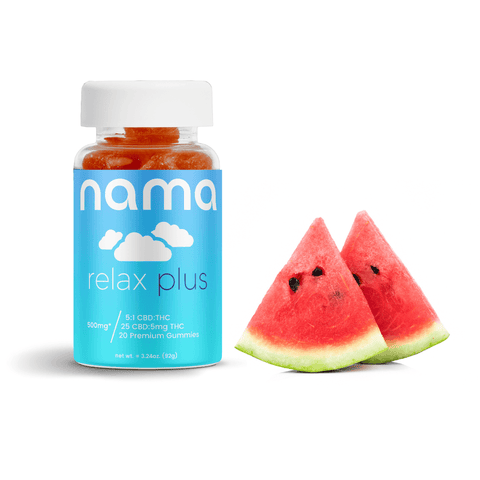
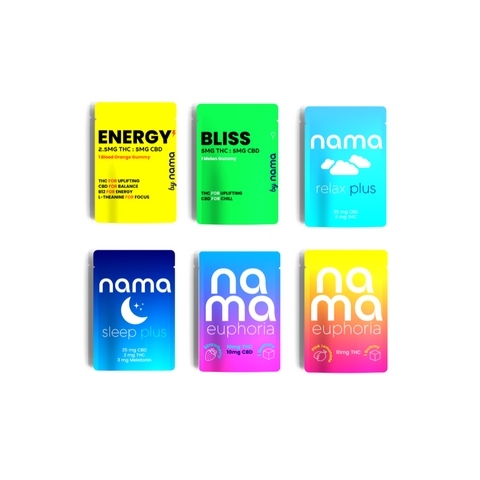
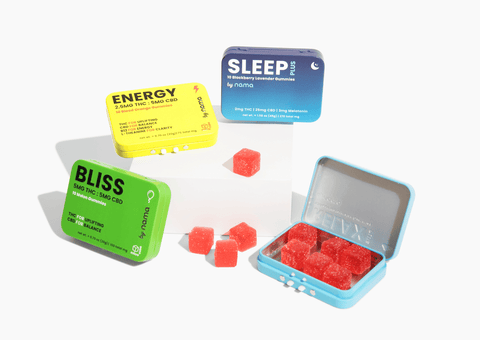
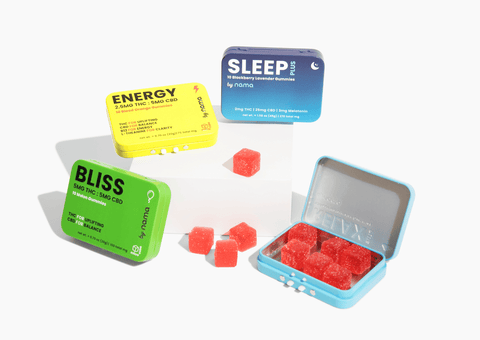
- Bliss gummies: 5 mg THC and 5 mg CBD per gummy
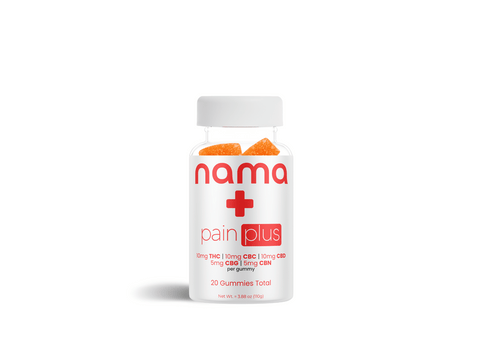
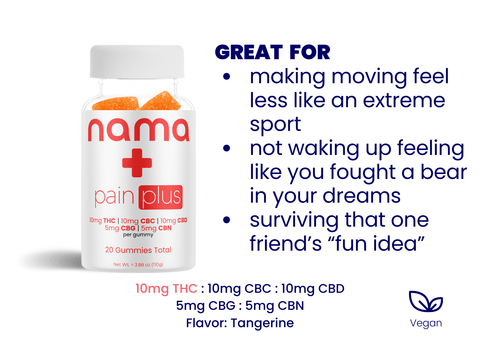
- Pain Plus gummies: five-cannabinoid formula (THC, CBC, CBD, CBG, CBN) for targeted relief
- Sleep Plus gummies: 2 mg THC, 25 mg CBD, and melatonin for sleep support
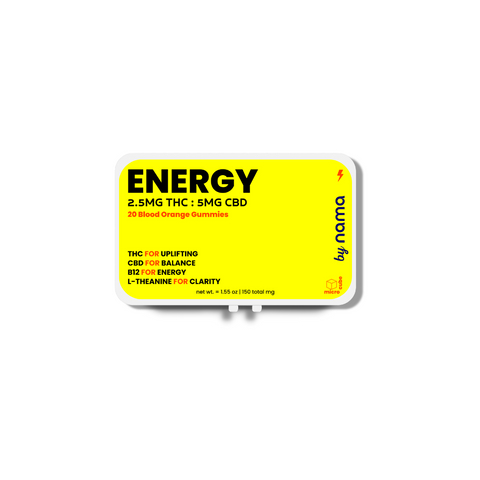
- Energy gummies: 2.5 mg THC and 5 mg CBD and B12 and L-theanine for focused energy
- The Ultimate nama sampler: single-serving introductions across the product line
Cannabis copycat avoidance FAQ
Trademark infringement is illegal, but enforcement is extremely expensive. The larger concern for consumers is safety, as counterfeit products aren't held to any testing or labeling standard, which means you have no guarantee of what's inside.
Buzz Drops became one of the most popular THC drink products in the US, which made the name valuable. Copycats exploit that name recognition to sell unrelated products to consumers who think they're getting the original. nama is the only company that makes Buzz Drops.
Stop using it. There is no way to verify its contents without lab testing. If you want authentic nama products, order from namacbd.com. If you're unsure whether a nama product you purchased is real, contact us at hello@namacbd.com.
Lab results can be fabricated or misrepresented. To verify a COA, check that it comes from a named, accredited laboratory, lists a specific batch number that matches your product, includes a recent test date, and shows results for potency, pesticides, heavy metals, solvents, and microbial contamination. If the COA is a generic document without batch-specific details, treat it as unreliable.
Top Sellers
New? Start with our Ultimate Sampler!
10mg THC | 10mg CBD | 10mg CBC | 5mg CBG | 5mg CBN (per gummy)
nama CBD FDA & legal disclaimer
Our products are not intended to diagnose, treat, cure, or prevent any disease. They are not a replacement for prescription medications and have not been evaluated by the Food and Drug Administration (FDA).
The information provided on this website does not and is not intended to constitute legal advice or any statements of the status of any laws. Any information, content, and materials available on this site are for general informational purposes only and are not intended to be relied upon for any purpose.
Readers of this website should contact their attorney to obtain advice concerning any particular legal matter, including decisions on what products are, or are not, legal to sell, possess, or consume. No reader, user, or browser of this site should act or refrain from acting based on information on this site without first seeking legal advice from their own counsel in the relevant jurisdiction.
Only your attorney can provide assurances that the information contained herein—and your interpretation of it—is applicable or accurate for your particular situation. Use of, and access to, this website or any of the links or resources contained within the site do not create an attorney-client relationship between the reader, user, or browser, and website authors, contributors, contributing law firms, or committee members and their respective employers.
About
Learn
Join us on this journey
© Copyright 2026 nama Products LLC. All Rights Reserved.
†These statements have not been evaluated by the Food and Drug Administration. These products are not intended to diagnose, treat, cure or prevent any disease. All information presented here is not meant as a substitute for or alternative to information from health care practitioners. Please consult your health care professional about potential interactions or other possible complications before using any product.
††The information provided on this website does not, and is not intended to, constitute legal advice or any statements of the status of any laws. Any information, content, and materials available on this site are for general entertainment purposes only, and are not intended to be relied upon for any purpose.
nama: The only source for Buzz Drops™
By clicking ‘Yes,’ you agree to our
Terms & Conditions and Privacy Policy
123 John Doe Street
Your Town, YT 12345
Store Hours
Sun: Closed
Mon-Fri: 9:00 - 17:00
Sat: 10:00 - 13:00
What to expect at pickup
Closed
Closing at 5pm
Closing at 5pm
Closing at 5pm
Closing at 5pm
Closing at 5pm
Closing at 1pm

Comments (0)
There are no comments for this article. Be the first one to leave a message!